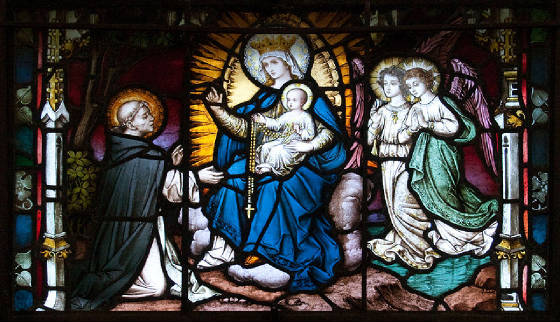
The Holy Rosary of Saint Mary - Apostolic Letter
1. The Rosary of the Virgin Mary, which gradually took form in the second millennium
under the guidance of the Spirit of God, is a prayer loved by countless Saints and encouraged by the Magisterium. Simple yet
profound, it still remains, at the dawn of this third millennium, a prayer of great significance, destined to bring forth
a harvest of holiness. It blends easily into the spiritual journey of the Christian life, which, after two thousand years,
has lost none of the freshness of its beginnings and feels drawn by the Spirit of God to "set out into the deep"
(duc in altum!) in order once more to proclaim, and even cry out, before the world that Jesus Christ is Lord and Saviour,
"the way, and the truth and the life" (Jn 14:6), "the goal of human history and the point on which the desires
of history and civilization turn".
The Rosary,
though clearly Marian in character, is at heart a Christocentric prayer. In the sobriety of its elements, it has all the depth
of the Gospel message in its entirety, of which it can be said to be a compendium. It is an echo of the prayerof Mary, her
perennial Magnificat for the work of the redemptive Incarnation which began in her virginal womb. With the Rosary, the Christian
people sits at the school of Mary and is led to contemplate the beauty on the face of Christ and to experience the depths
of his love. Through the Rosary the faithful receive abundant grace, as though from the very hands of the Mother of the Redeemer.
The
Popes and the Rosary
2. Numerous
predecessors of mine attributed great importance to this prayer. Worthy of special note in this regard is Pope Leo XIII who
on 1 September 1883 promulgated the Encyclical Supremi Apostolatus Officio, a document of great worth, the first of his many
statements about this prayer, in which he proposed the Rosary as an effective spiritual weapon against the evils afflicting
society. Among the more recent Popes who, from the time of the Second Vatican Council, have distinguished themselves in promoting
the Rosary I would mention Blessed John XXIII and above all Pope Paul VI, who in his Apostolic Exhortation Marialis Cultus
emphasized, in the spirit of the Second Vatican Council, the Rosary's evangelical character and its Christocentric inspiration.
I myself have often encouraged the frequent recitation of the Rosary. From my youthful years this prayer has held an important
place in my spiritual life. I was powerfully reminded of this during my recent visit to Poland, and in particular at the Shrine
of Kalwaria. The Rosary has accompanied me in moments of joy and in moments of difficulty. To it I have entrusted any number
of concerns; in it I have always found comfort. Twenty-four years ago, on 29 October 1978, scarcely two weeks after my election
to the See of Peter, I frankly admitted: "The Rosary is my favourite prayer. A marvellous prayer! Marvellous in its simplicity
and its depth. [...]. It can be said that the Rosary is, in some sense, a prayer-commentary on the final chapter of the Vatican
II Constitution Lumen Gentium, a chapter which discusses the wondrous presence of the Mother of God in the mystery of Christ
and the Church. Against the background of the words Ave Maria the principal events of the life of Jesus Christ pass before
the eyes of the soul. They take shape in the complete series of the joyful, sorrowful and glorious mysteries, and they put
us in living communion with Jesus through - we might say - the heart of his Mother. At the same time our heart can embrace
in the decades of the Rosary all the events that make up the lives of individuals, families, nations, the Church, and all
mankind. Our personal concerns and those of our neighbour, especially those who are closest to us, who are dearest to us.
Thus the simple prayer of the Rosary marks the rhythm of human life".
With these words, dear brothers and sisters, I set the first year of my Pontificate within the daily rhythm of the
Rosary. Today, as I begin the twenty-fifth year of my service as the Successor of Peter, I wish to do the same. How many graces
have I received in these years from the Blessed Virgin through the Rosary: Magnificat anima mea Dominum! I wish to lift up
my thanks to the Lord in the words of his Most Holy Mother, under whose protection I have placed my Petrine ministry: Totus
Tuus!
October
2002 - October 2003: The Year of the Rosary
3. Therefore, in continuity with my reflection in the Apostolic Letter Novo Millennio Ineunte, in which, after the
experience of the Jubilee, I invited the people of God to "start afresh from Christ", I have felt drawn to offer
a reflection on the Rosary, as a kind of Marian complement to that Letter and an exhortation to contemplate the face of Christ
in union with, and at the school of, his Most Holy Mother. To recite the Rosary is nothing other than to contemplate with
Mary the face of Christ. As a way of highlighting this invitation, prompted by the forthcoming 120th anniversary of the aforementioned
Encyclical of Leo XIII, I desire that during the course of this year the Rosary should be especially emphasized and promoted
in the various Christian communities. I therefore proclaim the year from October 2002 to October 2003 the Year of the Rosary.
I leave this pastoral proposal to the initiative
of each ecclesial community. It is not my intention to encumber but rather to complete and consolidate pastoral programmes
of the Particular Churches. I am confident that the proposal will find a ready and generous reception. The Rosary, reclaimed
in its full meaning, goes to the very heart of Christian life; it offers a familiar yet fruitful spiritual and educational
opportunity for personal contemplation, the formation of the People of God, and the new evangelization. I am pleased to reaffirm
this also in the joyful remembrance of another anniversary: the fortieth anniversary of the opening of the Second Vatican
Ecumenical Council on October 11, 1962, the "great grace" disposed by the Spirit of God for the Church in our time.
Objections to the Rosary
4. The timeliness of this proposal is evident from a number of
considerations. First, the urgent need to counter a certain crisis of the Rosary, which in the present historical and theological
context can risk being wrongly devalued, and therefore no longer taught to the younger generation. There are some who think
that the centrality of the Liturgy, rightly stressed by the Second Vatican Ecumenical Council, necessarily entails giving
lesser importance to the Rosary. Yet, as Pope Paul VI made clear, not only does this prayer not conflict with the Liturgy,
it sustains it, since it serves as an excellent introduction and a faithful echo of the Liturgy, enabling people to participate
fully and interiorly in it and to reap its fruits in their daily lives.
Perhaps too, there are some who fear that the Rosary is somehow unecumenical because of its distinctly Marian character.
Yet the Rosary clearly belongs to the kind of veneration of the Mother of God described by the Council: a devotion directed
to the Christological centre of the Christian faith, in such a way that "when the Mother is honoured, the Son ... is
duly known, loved and glorified". If properly revitalized, the Rosary is an aid and certainly not a hindrance to ecumenism!
A path of contemplation
5. But the most important reason for strongly encouraging the practice
of the Rosary is that it represents a most effective means of fostering among the faithful that commitment to the contemplation
of the Christian mystery which I have proposed in the Apostolic Letter Novo Millennio Ineunte as a genuine "training
in holiness": "What is needed is a Christian life distinguished above all in the art of prayer". Inasmuch as
contemporary culture, even amid so many indications to the contrary, has witnessed the flowering of a new call for spirituality,
due also to the influence of other religions, it is more urgent than ever that our Christian communities should become "genuine
schools of prayer".
The Rosary belongs among
the finest and most praiseworthy traditions of Christian contemplation. Developed in the West, it is a typically meditative
prayer, corresponding in some way to the "prayer of the heart" or "Jesus prayer" which took root in the
soil of the Christian East.
Prayer for peace and for the family
6. A number of historical circumstances also make a revival of the Rosary quite timely. First of all, the need to
implore from God the gift of peace. The Rosary has many times been proposed by my predecessors and myself as a prayer for
peace. At the start of a millennium which began with the terrifying attacks of 11 September 2001, a millennium which witnesses
every day innumerous parts of the world fresh scenes of bloodshed and violence, to rediscover the Rosary means to immerse
oneself in contemplation of the mystery of Christ who "is our peace", since he made "the two of us one, and
broke down the dividing wall of hostility" (Eph 2:14). Consequently, one cannot recite the Rosary without feeling caught
up in a clear commitment to advancing peace, especially in the land of Jesus, still so sorely afflicted and so close to the
heart of every Christian.
A similar need for commitment
and prayer arises in relation to another critical contemporary issue: the family, the primary cell of society, increasingly
menaced by forces of disintegration on both the ideological and practical planes, so as to make us fear for the future of
this fundamental and indispensable institution and, with it, for the future of society as a whole. The revival of the Rosary
in Christian families, within the context of a broader pastoral ministry to the family, will be an effective aid to countering
the devastating effects of this crisis typical of our age.
"Behold, your Mother!" (Jn 19:27)
7. Many signs indicate that still today the Blessed Virgin desires
to exercise through this same prayer that maternal concern to which the dying Redeemer entrusted, in the person of the beloved
disciple, all the sons and daughters of the Church: "Woman, behold your son!" (Jn19:26). Well-known are the occasions
in the nineteenth and the twentieth centuries on which the Mother of Christ made her presence felt and her voice heard, in
order to exhort the People of God to this form of contemplative prayer. I would mention in particular, on account of their
great influence on the lives of Christians and the authoritative recognition they have received from the Church, the apparitions
of Lourdes and of Fatima; these shrines continue to be visited by great numbers of pilgrims seeking comfort and hope.
Following the witnesses
8. It would be impossible to name all the many Saints who discovered
in the Rosary a genuine path to growth in holiness. We need but mention Saint Louis Marie Grignion de Montfort, the author
of an excellent work on the Rosary, and, closer to ourselves, Padre Pio of Pietrelcina, whom I recently had the joy of canonizing.
As a true apostle of the Rosary, Blessed Bartolo Longo had a special charism. His path to holiness rested on an inspiration
heard in the depths of his heart: "Whoever spreads the Rosary is saved!". As a result, he felt called to build a
Church dedicated to Our Lady of the Holy Rosary in Pompei, against the background of the ruins of the ancient city, which
scarcely heard the proclamation of Christ before being buried in 79 A.D. during an eruption of Mount Vesuvius, only to emerge
centuries later from its ashes as a witness to the lights and shadows of classical civilization. By his whole life's work
and especially by the practice of the "Fifteen Saturdays", Bartolo Longo promoted the Christocentric and contemplative
heart of the Rosary, and received great encouragement and support from Leo XIII, the "Pope of the Rosary".
CHAPTER
I
CONTEMPLATING CHRIST WITH MARY
A face radiant as the sun
9. "And he was transfigured before them, and his face shone like the sun"
(Mt 17:2). The Gospel scene of Christ's transfiguration, in which the three Apostles Peter, James and John appear entranced
by the beauty of the Redeemer, can be seen as an icon of Christian contemplation. To look upon the face of Christ, to recognize
its mystery amid the daily events and the sufferings of his human life, and then to grasp the divine splendour definitively
revealed in the Risen Lord, seated in glory at the right hand of the Father: this is the task of every follower of Christ
and therefore the task of each one of us. In contemplating Christ's face we become open to receiving the mystery of Trinitarian
life, experiencing ever anew the love of the Father and delighting in the joy of the Holy Spirit. Saint Paul's words can then
be applied to us: "Beholding the glory of the Lord, we are being changed into his likeness, from one degree of glory
to another; for this comes from the Lord who is the Spirit" (2Cor 3:18).
Mary, model of contemplation
10. The contemplation of Christ has an incomparable model in Mary. In a unique way the
face of the Son belongs to Mary. It was in her womb that Christ was formed, receiving from her a human resemblance which points
to an even greater spiritual closeness. No one has ever devoted himself to the contemplation of the face of Christ as faithfully
as Mary. The eyes of her heart already turned to him at the Annunciation, when she conceived him by the power of the Holy
Spirit. In the months that followed she began to sense his presence and to picture his features. When at last she gave birth
to him in Bethlehem, her eyes were able to gaze tenderly on the face of her Son, as she "wrapped him in swaddling cloths,
and laid him in a manger" (Lk2:7).
Thereafter
Mary's gaze, ever filled with adoration and wonder, would never leave him. At times it would be a questioning look, as in
the episode of the finding in the Temple: "Son, why have you treated us so?" (Lk 2:48); it would always be a penetrating
gaze, one capable of deeply understanding Jesus, even to the point of perceiving his hidden feelings and anticipating his
decisions, as at Cana (cf. Jn 2:5). At other times it would be a look of sorrow, especially beneath the Cross, where her vision
would still be that of a mother giving birth, for Mary not only shared the passion and death of her Son, she also received
the new son given to her in the beloved disciple (cf. Jn 19:26-27). On the morning of Easter hers would be a gaze radiant
with the joy of the Resurrection, and finally, on the day of Pentecost, a gaze afire with the outpouring of the Spirit (cf.
Acts 1:14).
Mary's
memories
11. Mary lived with her eyes fixed on Christ, treasuring his every word: "She kept all these things, pondering
them in her heart" (Lk 2:19; cf. 2:51). The memories of Jesus, impressed upon her heart, were always with her, leading
her to reflect on the various moments of her life at her Son's side. In a way those memories were to be the "rosary"
which she recited uninterruptedly throughout her earthly life.
Even now, amid the joyful songs of the heavenly Jerusalem, the reasons for her thanksgiving and praise remain unchanged.
They inspire her maternal concern for the pilgrim Church, in which she continues to relate her personal account of the Gospel.
Mary constantly sets before the faithful the "mysteries" of her Son, with the desire that the contemplation of those
mysteries will release all their saving power. In the recitation of the Rosary, the Christian community enters into contact
with the memories and the contemplative gaze of Mary.
The Rosary, a contemplative prayer
12. The Rosary, precisely because it starts
with Mary's own experience, is an exquisitely contemplative prayer. Without this contemplative dimension, it would lose its
meaning, as Pope Paul VI clearly pointed out: "Without contemplation, the Rosary is a body without a soul, and its recitation
runs the risk of becoming a mechanical repetition of formulas, in violation of the admonition of Christ: 'In praying do not
heap up empty phrases as the Gentiles do; for they think they will be heard for their many words' (Mt 6:7). By its nature
the recitation of the Rosary calls for a quiet rhythm and a lingering pace, helping the individual to meditate on the mysteries
of the Lord's life as seen through the eyes of her who was closest to the Lord. In this way the unfathomable riches of these
mysteries are disclosed".
It is worth
pausing to consider this profound insight of Paul VI, in order to bring out certain aspects of the Rosary which show that
it is really a form of Christocentric contemplation.
Remembering Christ with Mary
13. Mary's contemplation is above all a remembering. We need to understand this word
in the biblical sense of remembrance (zakar) as a making present of the works brought about by God in the history of salvation.
The Bible is an account of saving events culminating in Christ himself. These events not only belong to "yesterday";
they are also part of the "today" of salvation. This making present comes about above all in the Liturgy: what God
accomplished centuries ago did not only affect the direct witnesses of those events; it continues to affect people in every
age with its gift of grace. To some extent this is also true of every other devout approach to those events: to "remember"
them in a spirit of faith and love is to be open to the grace which Christ won for us by the mysteries of his life, death
and resurrection.
Consequently, while it must be
reaffirmed with the Second Vatican Council that the Liturgy, as the exercise of the priestly office of Christ and an act of
public worship, is "the summit to which the activity of the Church is directed and the font from which all its power
flows", it is also necessary to recall that the spiritual life "is not limited solely to participation in the liturgy.
Christians, while they are called to prayer in common, must also go to their own rooms to pray to their Father in secret (cf.
Mt 6:6); indeed, according to the teaching of the Apostle, they must pray without ceasing (cf.1Thes 5:17)".The Rosary,
in its own particular way, is part of this varied panorama of "ceaseless" prayer. If the Liturgy, as the activity
of Christ and the Church, is a saving action par excellence, the Rosary too, as a "meditation" with Mary on Christ,
is a salutary contemplation. By immersing us in the mysteries of the Redeemer's life, it ensures that what he has done and
what the liturgy makes present is profoundly assimilated and shapes our existence.
Learning Christ from Mary
14. Christ is the supreme Teacher, the revealer and the one revealed.
It is not just a question of learning what he taught but of "learning him". In this regard could we have any better
teacher than Mary? From the divine standpoint, the Spirit is the interior teacher who leads us to the full truth of Christ
(cf. Jn 14:26; 15:26; 16:13). But among creatures no one knows Christ better than Mary; no one can introduce us to a profound
knowledge of his mystery better than his Mother.
The
first of the "signs" worked by Jesus - the changing of water into wine at the marriage in Cana - clearly presents
Mary in the guise of a teacher, as she urges the servants to do what Jesus commands (cf. Jn 2:5). We can imagine that she
would have done likewise for the disciples after Jesus' Ascension, when she joined them in awaiting the Holy Spirit and supported
them in their first mission. Contemplating the scenes of the Rosary in union with Mary is a means of learning from her to
"read" Christ, to discover his secrets and to understand his message.
This school of Mary is all the more effective if we consider that she teaches by obtaining for
us in abundance the gifts of the Holy Spirit, even as she offers us the incomparable example of her own "pilgrimage of
faith". As we contemplate each mystery of her Son's life, she invites us to do as she did at the Annunciation: to ask
humbly the questions which open us to the light, in order to end with the obedience of faith: "Behold I am the handmaid
of the Lord; be it done to me according to your word" (Lk 1:38).
Being conformed to Christ with Mary
15. Christian spirituality is distinguished by the disciple's commitment to become conformed
ever more fully to his Master (cf. Rom 8:29; Phil 3:10,12). The outpouring of the Holy Spirit in Baptism grafts the believer
like a branch onto the vine which is Christ (cf. Jn 15:5) and makes him a member of Christ's mystical Body (cf.1Cor 12:12;
Rom 12:5). This initial unity, however, calls for a growing assimilation which will increasingly shape the conduct of the
disciple in accordance with the "mind" of Christ: "Have this mind among yourselves, which was in Christ Jesus"
(Phil 2:5). In the words of the Apostle, we are called "to put on the Lord Jesus Christ" (cf. Rom 13:14; Gal 3:27).
In the spiritual journey of the Rosary, based on the constant contemplation
- in Mary's company - of the face of Christ, this demanding ideal of being conformed to him is pursued through an association
which could be described in terms of friendship. We are thereby enabled to enter naturally into Christ's life and as it were
to share his deepest feelings. In this regard Blessed Bartolo Longo has written: "Just as two friends, frequently in
each other's company, tend to develop similar habits, so too, by holding familiar converse with Jesus and the Blessed Virgin,
by meditating on the mysteries of the Rosary and by living the same life in Holy Communion, we can become, to the extent of
our lowliness, similar to them and can learn from these supreme models a life of humility, poverty, hiddenness, patience and
perfection".
In this process of being conformed
to Christ in the Rosary, we entrust ourselves in a special way to the maternal care of the Blessed Virgin. She who is both
the Mother of Christ and a member of the Church, indeed her "pre-eminent and altogether singular member", is at
the same time the "Mother of the Church". As such, she continually brings to birth children for the mystical Body
of her Son. She does so through her intercession, imploring upon them the inexhaustible outpouring of the Spirit. Mary is
the perfect icon of the motherhood of the Church.
The
Rosary mystically transports us to Mary's side as she is busy watching over the human growth of Christ in the home of Nazareth.
This enables her to train us and to mold us with the same care, until Christ is "fully formed" in us (cf. Gal 4:19).
This role of Mary, totally grounded in that of Christ and radically subordinated to it, "in no way obscures or diminishes
the unique mediation of Christ, but rather shows its power". This is the luminous principle expressed by the Second Vatican
Council which I have so powerfully experienced in my own life and have made the basis of my episcopal motto: Totus Tuus. The
motto is of course inspired by the teaching of Saint Louis Marie Grignion de Montfort, who explained in the following words
Mary's role in the process of our configuration to Christ: "Our entire perfection consists in being conformed, united
and consecrated to Jesus Christ. Hence the most perfect of all devotions is undoubtedly that which conforms, unites and consecrates
us most perfectly to Jesus Christ. Now, since Mary is of all creatures the one most conformed to Jesus Christ, it follows
that among all devotions that which most consecrates and conforms a soul to our Lord is devotion to Mary, his Holy Mother,
and that the more a soul is consecrated to her the more will it be consecrated to Jesus Christ". Never as in the Rosary
do the life of Jesus and that of Mary appear so deeply joined. Mary lives only in Christ and for Christ!
Praying to Christ with Mary
16. Jesus invited us to turn to God with insistence and the confidence
that we will be heard: "Ask, and it will be given to you; seek, and you will find; knock, and it will be opened to you"
(Mt 7:7). The basis for this power of prayer is the goodness of the Father, but also the mediation of Christ himself (cf.
1Jn 2:1) and the working of the Holy Spirit who "intercedes for us" according to the will of God (cf. Rom 8:26-27).
For "we do not know how to pray as we ought" (Rom 8:26), and at times we are not heard "because we ask wrongly"
(cf. Jas 4:2-3).
In support of the prayer which Christ
and the Spirit cause to rise in our hearts, Mary intervenes with her maternal intercession. "The prayer of the Church
is sustained by the prayer of Mary". If Jesus, the one Mediator, is the Way of our prayer, then Mary, his purest and
most transparent reflection, shows us the Way. "Beginning with Mary's unique cooperation with the working of the Holy
Spirit, the Churches developed their prayer to the Holy Mother of God, centering it on the person of Christ manifested in
his mysteries". At the wedding of Cana the Gospel clearly shows the power of Mary's intercession as she makes known to
Jesus the needs of others: "They have no wine" (Jn 2:3).
The Rosary is both meditation and supplication. Insistent prayer to the Mother of God is based on confidence that
her maternal intercession can obtain all things from the heart of her Son. She is "all-powerful by grace", to use
the bold expression, which needs to be properly understood, of Blessed Bartolo Longo in his Supplication to Our Lady. This
is a conviction which, beginning with the Gospel, has grown ever more firm in the experience of the Christian people. The
supreme poet Dante expresses it marvellously in the lines sung by Saint Bernard: "Lady, thou art so great and so powerful,
that whoever desires grace yet does not turn to thee, would have his desire fly without wings". When in the Rosary we
plead with Mary, the sanctuary of the Holy Spirit (cf. Lk 1:35), she intercedes for us before the Father who filled her with
grace and before the Son born of her womb, praying with us and for us.
Proclaiming Christ with Mary
17. The Rosary is also a path of proclamation and increasing knowledge, in which the
mystery of Christ is presented again and again at different levels of the Christian experience. Its form is that of a prayerful
and contemplative presentation, capable of forming Christians according to the heart of Christ. When the recitation of the
Rosary combines all the elements needed for an effective meditation, especially in its communal celebration in parishes and
shrines, it can present a significant catechetical opportunity which pastors should use to advantage. In this way too Our
Lady of the Rosary continues her work of proclaiming Christ. The history of the Rosary shows how this prayer was used in particular
by the Dominicans at a difficult time for the Church due to the spread of heresy. Today we are facing new challenges. Why
should we not once more have recourse to the Rosary, with the same faith as those who have gone before us? The Rosary retains
all its power and continues to be a valuable pastoral resource for every good evangelizer.
CHAPTER
II
MYSTERIES OF CHRIST - MYSTERIES
OF HIS MOTHER
The Rosary, "a compendium of the Gospel"
18. The only way to approach the contemplation of Christ's face is by listening in the Spirit to
the Father's voice, since "no one knows the Son except the Father" (Mt 11:27). In the region of Caesarea Philippi,
Jesus responded to Peter's confession of faith by indicating the source of that clear intuition of his identity: "Flesh
and blood has not revealed this to you, but my Father who is in heaven" (Mt 16:17). What is needed, then, is a revelation
from above. In order to receive that revelation, attentive listening is indispensable: "Only the experience of silence
and prayer offers the proper setting for the growth and development of a true, faithful and consistent knowledge of that mystery".
The Rosary is one of the traditional paths of Christian prayer
directed to the contemplation of Christ's face. Pope Paul VI described it in these words: "As a Gospel prayer, centred
on the mystery of the redemptive Incarnation, the Rosary is a prayer with a clearly Christological orientation. Its most characteristic
element, in fact, the litany- like succession of Hail Marys, becomes in itself an unceasing praise of Christ, who is the ultimate
object both of the Angel's announcement and of the greeting of the Mother of John the Baptist: 'Blessed is the fruit of your
womb' (Lk 1:42). We would go further and say that the succession of Hail Marys constitutes the warp on which is woven the
contemplation of the mysteries. The Jesus that each Hail Mary recalls is the same Jesus whom the succession of mysteries proposes
to us now as the Son of God, now as the Son of the Virgin".
A proposed addition to the traditional pattern
19. Of the many mysteries of Christ's life, only a few are indicated
by the Rosary in the form that has become generally established with the seal of the Church's approval. The selection was
determined by the origin of the prayer, which was based on the number 150, the number of the Psalms in the Psalter.
I believe, however, that to bring out fully the Christological
depth of the Rosary it would be suitable to make an addition to the traditional pattern which, while left to the freedom of
individuals and communities, could broaden it to include the mysteries of Christ's public ministry between his Baptism and
his Passion. In the course of those mysteries we contemplate important aspects of the person of Christ as the definitive revelation
of God. Declared the beloved Son of the Father at the Baptism in the Jordan, Christ is the one who announces the coming of
the Kingdom, bears witness to it in his works and proclaims its demands. It is during the years of his public ministry that
the mystery of Christ is most evidently a mystery of light: "While I am in the world, I am the light of the world"
(Jn 9:5).
Consequently, for the Rosary to become more
fully a "compendium of the Gospel", it is fitting to add, following reflection on the Incarnation and the hidden
life of Christ (the joyful mysteries) and before focusing on the sufferings of his Passion (the sorrowful mysteries) and the
triumph of his Resurrection (the glorious mysteries), a meditation on certain particularly significant moments in his public
ministry (the mysteries of light). This addition of these new mysteries, without prejudice to any essential aspect of the
prayer's traditional format, is meant to give it fresh life and to enkindle renewed interest in the Rosary's place within
Christian spirituality as a true doorway to the depths of the Heart of Christ, ocean of joy and of light, of suffering and
of glory.
The
Joyful Mysteries
20. The first
five decades, the "joyful mysteries", are marked by the joy radiating from the event of the Incarnation. This is
clear from the very first mystery, the Annunciation, where Gabriel's greeting to the Virgin of Nazareth is linked to an invitation
to messianic joy: "Rejoice, Mary". The whole of salvation history, in some sense the entire history of the world,
has led up to this greeting. If it is the Father's plan to unite all things in Christ (cf. Eph 1:10), then the whole of the
universe is in some way touched by the divine favour with which the Father looks upon Mary and makes her the Mother of his
Son. The whole of humanity, in turn, is embraced by the fiat with which she readily agrees to the will of God.
Exultation is the keynote of the encounter with Elizabeth, where
the sound of Mary's voice and the presence of Christ in her womb cause John to "leap for joy" (cf. Lk 1:44). Gladness
also fills the scene in Bethlehem, when the birth of the divine Child, the Saviour of the world, is announced by the song
of the angels and proclaimed to the shepherds as "news of great joy" (Lk 2:10).
The final two mysteries, while preserving this climate of joy, already point to the
drama yet to come. The Presentation in the Temple not only expresses the joy of the Child's consecration and the ecstasy of
the aged Simeon; it also records the prophecy that Christ will be a "sign of contradiction" for Israel and that
a sword will pierce his mother's heart (cf Lk 2:34-35). Joy mixed with drama marks the fifth mystery, the finding of the twelve-year-old
Jesus in the Temple. Here he appears in his divine wisdom as he listens and raises questions, already in effect one who "teaches".
The revelation of his mystery as the Son wholly dedicated to his Father's affairs proclaims the radical nature of the Gospel,
in which even the closest of human relationships are challenged by the absolute demands of the Kingdom. Mary and Joseph, fearful
and anxious, "did not understand" his words (Lk 2:50).
To meditate upon the "joyful" mysteries, then, is to enter into the ultimate causes and the deepest meaning
of Christian joy. It is to focus on the realism of the mystery of the Incarnation and on the obscure foreshadowing of the
mystery of the saving Passion. Mary leads us to discover the secret of Christian joy, reminding us that Christianity is, first
and foremost, euangelion, "good news", which has as its heart and its whole content the person of Jesus Christ,
the Word made flesh, the one Saviour of the world.
The Mysteries of Light
21. Moving on from the infancy and the hidden life
in Nazareth to the public life of Jesus, our contemplation brings us to those mysteries which may be called in a special way
"mysteries of light". Certainly the whole mystery of Christ is a mystery of light. He is the "light of the
world" (Jn 8:12). Yet this truth emerges in a special way during the years of his public life, when he proclaims the
Gospel of the Kingdom. In proposing to the Christian community five significant moments - "luminous" mysteries -
during this phase of Christ's life, I think that the following can be fittingly singled out: (1) his Baptism in the Jordan,
(2) his self-manifestation at the wedding of Cana, (3) his proclamation of the Kingdom of God, with his call to conversion,
(4) his Transfiguration, and finally, (5) his institution of the Eucharist, as the sacramental expression of the Paschal Mystery.
Each of these mysteries is a revelation of the Kingdom now present
in the very person of Jesus. The Baptism in the Jordan is first of all a mystery of light. Here, as Christ descends into the
waters, the innocent one who became "sin" for our sake (cf. 2Cor 5:21), the heavens open wide and the voice of the
Father declares him the beloved Son (cf. Mt 3:17 and parallels), while the Spirit descends on him to invest him with the mission
which he is to carry out. Another mystery of light is the first of the signs, given at Cana (cf. Jn 2:1- 12), when Christ
changes water into wine and opens the hearts of the disciples to faith, thanks to the intervention of Mary, the first among
believers. Another mystery of light is the preaching by which Jesus proclaims the coming of the Kingdom of God, calls to conversion
(cf. Mk 1:15) and forgives the sins of all who draw near to him in humble trust (cf. Mk 2:3-13; Lk 7:47- 48): the inauguration
of that ministry of mercy which he continues to exercise until the end of the world, particularly through the Sacrament of
Reconciliation which he has entrusted to his Church (cf. Jn 20:22-23). The mystery of light par excellence is the Transfiguration,
traditionally believed to have taken place on Mount Tabor. The glory of the Godhead shines forth from the face of Christ as
the Father commands the astonished Apostles to "listen to him" (cf. Lk 9:35 and parallels) and to prepare to experience
with him the agony of the Passion, so as to come with him to the joy of the Resurrection and a life transfigured by the Holy
Spirit. A final mystery of light is the institution of the Eucharist, in which Christ offers his body and blood as food under
the signs of bread and wine, and testifies "to the end" his love for humanity (Jn 13:1), for whose salvation he
will offer himself in sacrifice.
In these mysteries,
apart from the miracle at Cana, the presence of Mary remains in the background. The Gospels make only the briefest reference
to her occasional presence at one moment or other during the preaching of Jesus (cf. Mk 3:31-5; Jn 2:12), and they give no
indication that she was present at the Last Supper and the institution of the Eucharist. Yet the role she assumed at Cana
in some way accompanies Christ throughout his ministry. The revelation made directly by the Father at the Baptism in the Jordan
and echoed by John the Baptist is placed upon Mary's lips at Cana, and it becomes the great maternal counsel which Mary addresses
to the Church of every age: "Do whatever he tells you" (Jn 2:5). This counsel is a fitting introduction to the words
and signs of Christ's public ministry and it forms the Marian foundation of all the "mysteries of light".
The Sorrowful Mysteries
22. The Gospels give great prominence to the sorrowful mysteries
of Christ. From the beginning Christian piety, especially during the Lenten devotion of the Way of the Cross, has focused
on the individual moments of the Passion, realizing that here is found the culmination of the revelation of God's love and
the source of our salvation. The Rosary selects certain moments from the Passion, inviting the faithful to contemplate them
in their hearts and to relive them. The sequence of meditations begins with Gethsemane, where Christ experiences a moment
of great anguish before the will of the Father, against which the weakness of the flesh would be tempted to rebel. There Jesus
encounters all the temptations and confronts all the sins of humanity, in order to say to the Father: "Not my will but
yours be done" (Lk 22:42 and parallels). This "Yes" of Christ reverses the "No" of our first parents
in the Garden of Eden. And the cost of this faithfulness to the Father's will is made clear in the following mysteries; by
his scourging, his crowning with thorns, his carrying the Cross and his death on the Cross, the Lord is cast into the most
abject suffering: Ecce homo!
This abject suffering
reveals not only the love of God but also the meaning of man himself.
Ecce homo: the meaning, origin and fulfilment of man is to be found in Christ, the God who humbles himself out of
love "even unto death, death on a cross" (Phil 2:8). The sorrowful mysteries help the believer to relive the death
of Jesus, to stand at the foot of the Cross beside Mary, to enter with her into the depths of God's love for man and to experience
all its life-giving power.
The Glorious Mysteries
23.
"The contemplation of Christ's face cannot stop at the image of the Crucified One. He is the Risen One!" The Rosary
has always expressed this knowledge born of faith and invited the believer to pass beyond the darkness of the Passion in order
to gaze upon Christ's glory in the Resurrection and Ascension. Contemplating the Risen One, Christians rediscover the reasons
for their own faith (cf. 1Cor 15:14) and relive the joy not only of those to whom Christ appeared - the Apostles, Mary Magdalene
and the disciples on the road to Emmaus - but also the joy of Mary, who must have had an equally intense experience of the
new life of her glorified Son. In the Ascension, Christ was raised in glory to the right hand of the Father, while Mary herself
would be raised to that same glory in the Assumption, enjoying beforehand, by a unique privilege, the destiny reserved for
all the just at the resurrection of the dead. Crowned in glory - as she appears in the last glorious mystery - Mary shines
forth as Queen of the Angels and Saints, the anticipation and the supreme realization of the eschatological state of the Church.
At the centre of this unfolding sequence of the glory of the Son
and the Mother, the Rosary sets before us the third glorious mystery, Pentecost, which reveals the face of the Church as a
family gathered together with Mary, enlivened by the powerful outpouring of the Spirit and ready for the mission of evangelization.
The contemplation of this scene, like that of the other glorious mysteries, ought to lead the faithful to an ever greater
appreciation of their new life in Christ, lived in the heart of the Church, a life of which the scene of Pentecost itself
is the great "icon". The glorious mysteries thus lead the faithful to greater hope for the eschatological goal towards
which they journey as members of the pilgrim People of God in history. This can only impel them to bear courageous witness
to that "good news" which gives meaning to their entire existence.
From "mysteries" to the "Mystery": Mary's way
24. The cycles of meditation proposed by the Holy Rosary are by
no means exhaustive, but they do bring to mind what is essential and they awaken in the soul a thirst for a knowledge of Christ
continually nourished by the pure source of the Gospel. Every individual event in the life of Christ, as narrated by the Evangelists,
is resplendent with the Mystery that surpasses all understanding (cf. Eph 3:19): the Mystery of the Word made flesh, in whom
"all the fullness of God dwells bodily" (Col 2:9). For this reason the Catechism of the Catholic Church places great
emphasis on the mysteries of Christ, pointing out that "everything in the life of Jesus is a sign of his Mystery".
The "duc in altum" of the Church of the third millennium will be determined by the ability of Christians to enter
into the "perfect knowledge of God's mystery, of Christ, in whom are hidden all the treasures of wisdom and knowledge"
(Col 2:2-3). The Letter to the Ephesians makes this heartfelt prayer for all the baptized: "May Christ dwell in your
hearts through faith, so that you, being rooted and grounded in love, may have power... to know the love of Christ which surpasses
knowledge, that you may be filled with all the fullness of God" (3:17-19).
The Rosary is at the service of this ideal; it offers the "secret" which leads easily
to a profound and inward knowledge of Christ. We might call it Mary's way. It is the way of the example of the Virgin of Nazareth,
a woman of faith, of silence, of attentive listening. It is also the way of a Marian devotion inspired by knowledge of the
inseparable bond between Christ and his Blessed Mother: the mysteries of Christ are also in some sense the mysteries of his
Mother, even when they do not involve her directly, for she lives from him and through him. By making our own the words of
the Angel Gabriel and Saint Elizabeth contained in the Hail Mary, we find ourselves constantly drawn to seek out afresh in
Mary, in her arms and in her heart, the "blessed fruit of her womb" (cf Lk 1:42).
Mystery of Christ, mystery of man
25. In my testimony of 1978 mentioned above, where I described
the Rosary as my favourite prayer, I used an idea to which I would like to return. I said then that "the simple prayer
of the Rosary marks the rhythm of human life".
In
the light of what has been said so far on the mysteries of Christ, it is not difficult to go deeper into this anthropological
significance of the Rosary, which is far deeper than may appear at first sight. Anyone who contemplates Christ through the
various stages of his life cannot fail to perceive in him the truth about man. This is the great affirmation of the Second
Vatican Council which I have so often discussed in my own teaching since the Encyclical Letter Redemptor Hominis: "it
is only in the mystery of the Word made flesh that the mystery of man is seen in its true light". The Rosary helps to
open up the way to this light. Following in the path of Christ, in whom man's path is "recapitulated", revealed
and redeemed, believers come face to face with the image of the true man. Contemplating Christ's birth, they learn of the
sanctity of life; seeing the household of Nazareth, they learn the original truth of the family according to God's plan; listening
to the Master in the mysteries of his public ministry, they find the light which leads them to enter the Kingdom of God; and
following him on the way to Calvary, they learn the meaning of salvific suffering. Finally, contemplating Christ and his Blessed
Mother in glory, they see the goal towards which each of us is called, if we allow ourselves to be healed and transformed
by the Holy Spirit. It could be said that each mystery of the Rosary, carefully meditated, sheds light on the mystery of man.
At the same time, it becomes natural to bring to
this encounter with the sacred humanity of the Redeemer all the problems, anxieties, labours and endeavours which go to make
up our lives. "Cast your burden on the Lord and he will sustain you" (Ps 55:23). To pray the Rosary is to hand over
our burdens to the merciful hearts of Christ and his Mother. Twenty-five years later, thinking back over the difficulties
which have also been part of my exercise of the Petrine ministry, I feel the need to say once more, as a warm invitation to
everyone to experience it personally: the Rosary does indeed "mark the rhythm of human life", bringing it into harmony
with the "rhythm" of God's own life, in the joyful communion of the Holy Trinity, our life's destiny and deepest
longing.
CHAPTER
III
"FOR ME, TO LIVE IS CHRIST"
The Rosary, a way of assimilating the mystery
26. Meditation on the mysteries of Christ is proposed in the Rosary
by means of a method designed to assist in their assimilation. It is a method based on repetition. This applies above all
to the Hail Mary, repeated ten times in each mystery. If this repetition is considered superficially, there could be a temptation
to see the Rosary as a dry and boring exercise. It is quite another thing, however, when the Rosary is thought of as an outpouring
of that love which tirelessly returns to the person loved with expressions similar in their content but ever fresh in terms
of the feeling pervading them.
In Christ, God has
truly assumed a "heart of flesh". Not only does God have a divine heart, rich in mercy and in forgiveness, but also
a human heart, capable of all the stirrings of affection. If we needed evidence for this from the Gospel, we could easily
find it in the touching dialogue between Christ and Peter after the Resurrection: "Simon, son of John, do you love me?"
Three times this question is put to Peter, and three times he gives the reply: "Lord, you know that I love you"
(cf. Jn 21:15-17). Over and above the specific meaning of this passage, so important for Peter's mission, none can fail to
recognize the beauty of this triple repetition, in which the insistent request and the corresponding reply are expressed in
terms familiar from the universal experience of human love. To understand the Rosary, one has to enter into the psychological
dynamic proper to love.
One thing is clear: although
the repeated Hail Mary is addressed directly to Mary, it is to Jesus that the act of love is ultimately directed, with her
and through her. The repetition is nourished by the desire to be conformed ever more completely to Christ, the true programme
of the Christian life. Saint Paul expressed this project with words of fire: "For me to live is Christ and to die is
gain" (Phil 1:21). And again: "It is no longer I that live, but Christ lives in me" (Gal 2:20). The Rosary
helps us to be conformed ever more closely to Christ until we attain true holiness.
A valid method...
27. We
should not be surprised that our relationship with Christ makes use of a method. God communicates himself to us respecting
our human nature and its vital rhythms. Hence, while Christian spirituality is familiar with the most sublime forms of mystical
silence in which images, words and gestures are all, so to speak, superseded by an intense and ineffable union with God, it
normally engages the whole person in all his complex psychological, physical and relational reality.
This becomes apparent in the Liturgy. Sacraments and sacramentals are structured as
a series of rites which bring into play all the dimensions of the person. The same applies to non-liturgical prayer. This
is confirmed by the fact that, in the East, the most characteristic prayer of Christological meditation, centred on the words
"Lord Jesus Christ, Son of God, have mercy on me, a sinner" is traditionally linked to the rhythm of breathing;
while this practice favours perseverance in the prayer, it also in some way embodies the desire for Christ to become the breath,
the soul and the "all" of one's life.
...
which can nevertheless be improved
28. I mentioned
in my Apostolic Letter Novo Millennio Ineunte that the West is now experiencing a renewed demand for meditation, which at
times leads to a keen interest in aspects of other religions. Some Christians, limited in their knowledge of the Christian
contemplative tradition, are attracted by those forms of prayer. While the latter contain many elements which are positive
and at times compatible with Christian experience, they are often based on ultimately unacceptable premises. Much in vogue
among these approaches are methods aimed at attaining a high level of spiritual concentration by using techniques of a psychophysical,
repetitive and symbolic nature. The Rosary is situated within this broad gamut of religious phenomena, but it is distinguished
by characteristics of its own which correspond to specifically Christian requirements.
In effect, the Rosary is simply a method of contemplation. As a method, it serves as a means to
an end and cannot become an end in itself. All the same, as the fruit of centuries of experience, this method should not be
undervalued. In its favour one could cite the experience of countless Saints. This is not to say, however, that the method
cannot be improved. Such is the intent of the addition of the new series of mysteria lucis to the overall cycle of mysteries
and of the few suggestions which I am proposing in this Letter regarding its manner of recitation. These suggestions, while
respecting the well-established structure of this prayer, are intended to help the faithful to understand it in the richness
of its symbolism and in harmony with the demands of daily life. Otherwise there is a risk that the Rosary would not only fail
to produce the intended spiritual effects, but even that the beads, with which it is usually said, could come to be regarded
as some kind of amulet or magic object, thereby radically distorting their meaning and function.
Announcing each mystery
29. Announcing each mystery, and perhaps even using a suitable
icon to portray it, is as it were to open up a scenario on which to focus our attention. The words direct the imagination
and the mind towards a particular episode or moment in the life of Christ. In the Church's traditional spirituality, the veneration
of icons and the many devotions appealing to the senses, as well as the method of prayer proposed by Saint Ignatius of Loyola
in the Spiritual Exercises, make use of visual and imaginative elements (the compositio loci), judged to be of great help
in concentrating the mind on the particular mystery. This is a methodology, moreover, which corresponds to the inner logic
of the Incarnation: in Jesus, God wanted to take on human features. It is through his bodily reality that we are led into
contact with the mystery of his divinity.
This need
for concreteness finds further expression in the announcement of the various mysteries of the Rosary. Obviously these mysteries
neither replace the Gospel nor exhaust its content. The Rosary, therefore, is no substitute for lectio divina; on the contrary,
it presupposes and promotes it. Yet, even though the mysteries contemplated in the Rosary, even with the addition of the mysteria
lucis, do no more than outline the fundamental elements of the life of Christ, they easily draw the mind to a more expansive
reflection on the rest of the Gospel, especially when the Rosary is prayed in a setting of prolonged recollection.
Listening to the word
of God
30. In order to supply
a Biblical foundation and greater depth to our meditation, it is helpful to follow the announcement of the mystery with the
proclamation of a related Biblical passage, long or short, depending on the circumstances. No other words can ever match the
efficacy of the inspired word. As we listen, we are certain that this is the word of God, spoken for today and spoken "for
me".
If received in this way, the word of God
can become part of the Rosary's methodology of repetition without giving rise to the ennui derived from the simple recollection
of something already well known. It is not a matter of recalling information but of allowing God to speak. In certain solemn
communal celebrations, this word can be appropriately illustrated by a brief commentary.
Silence
31. Listening and meditation are nourished by silence. After the announcement of the
mystery and the proclamation of the word, it is fitting to pause and focus one's attention for a suitable period of time on
the mystery concerned, before moving into vocal prayer. A discovery of the importance of silence is one of the secrets of
practicing contemplation and meditation. One drawback of a society dominated by technology and the mass media is the fact
that silence becomes increasingly difficult to achieve. Just as moments of silence are recommended in the Liturgy, so too
in the recitation of the Rosary it is fitting to pause briefly after listening to the word of God, while the mind focuses
on the content of a particular mystery.
The "Our Father"
32.
After listening to the word and focusing on the mystery, it is natural for the mind to be lifted up towards the Father. In
each of his mysteries, Jesus always leads us to the Father, for as he rests in the Father's bosom (cf. Jn 1:18) he is continually
turned towards him. He wants us to share in his intimacy with the Father, so that we can say with him: "Abba, Father"
(Rom 8:15; Gal 4:6). By virtue of his relationship to the Father he makes us brothers and sisters of himself and of one another,
communicating to us the Spirit which is both his and the Father's. Acting as a kind of foundation for the Christological and
Marian meditation which unfolds in the repetition of the Hail Mary, the Our Father makes meditation upon the mystery, even
when carried out in solitude, an ecclesial experience.
The ten "Hail Marys"
33. This is the most substantial element in the Rosary and also the one which makes
it a Marian prayer par excellence. Yet when the Hail Mary is properly understood, we come to see clearly that its Marian character
is not opposed to its Christological character, but that it actually emphasizes and increases it. The first part of the Hail
Mary, drawn from the words spoken to Mary by the Angel Gabriel and by Saint Elizabeth, is a contemplation in adoration of
the mystery accomplished in the Virgin of Nazareth. These words express, so to speak, the wonder of heaven and earth; they
could be said to give us a glimpse of God's own wonderment as he contemplates his "masterpiece" - the Incarnation
of the Son in the womb of the Virgin Mary. If we recall how, in the Book of Genesis, God "saw all that he had made"
(Gen 1:31), we can find here an echo of that "pathos with which God, at the dawn of creation, looked upon the work of
his hands". The repetition of the Hail Mary in the Rosary gives us a share in God's own wonder and pleasure: in jubilant
amazement we acknowledge the greatest miracle of history. Mary's prophecy here finds its fulfilment: "Henceforth all
generations will call me blessed" (Lk 1:48).
The
centre of gravity in the Hail Mary, the hinge as it were which joins its two parts, is the name of Jesus. Sometimes, in hurried
recitation, this centre of gravity can be overlooked, and with it the connection to the mystery of Christ being contemplated.
Yet it is precisely the emphasis given to the name of Jesus and to his mystery that is the sign of a meaningful and fruitful
recitation of the Rosary. Pope Paul VI drew attention, in his Apostolic Exhortation Marialis Cultus, to the custom in certain
regions of highlighting the name of Christ by the addition of a clause referring to the mystery being contemplated. This is
a praiseworthy custom, especially during public recitation. It gives forceful expression to our faith in Christ, directed
to the different moments of the Redeemer's life. It is at once a profession of faith and an aid in concentrating our meditation,
since it facilitates the process of assimilation to the mystery of Christ inherent in the repetition of the Hail Mary. When
we repeat the name of Jesus - the only name given to us by which we may hope for salvation (cf. Acts 4:12) - in close association
with the name of his Blessed Mother, almost as if it were done at her suggestion, we set out on a path of assimilation meant
to help us enter more deeply into the life of Christ.
From
Mary's uniquely privileged relationship with Christ, which makes her the Mother of God, Theotókos, derives the forcefulness
of the appeal we make to her in the second half of the prayer, as we entrust to her maternal intercession our lives and the
hour of our death.
The "Gloria"
34. Trinitarian doxology is the goal of all Christian contemplation. For Christ is
the way that leads us to the Father in the Spirit. If we travel this way to the end, we repeatedly encounter the mystery of
the three divine Persons, to whom all praise, worship and thanksgiving are due. It is important that the Gloria, the high-point
of contemplation, be given due prominence in the Rosary. In public recitation it could be sung, as a way of giving proper
emphasis to the essentially Trinitarian structure of all Christian prayer.
To the extent that meditation on the mystery is attentive and profound, and to the extent that
it is enlivened - from one Hail Mary to another - by love for Christ and for Mary, the glorification of the Trinity at the
end of each decade, far from being a perfunctory conclusion, takes on its proper contemplative tone, raising the mind as it
were to the heights of heaven and enabling us in some way to relive the experience of Tabor, a foretaste of the contemplation
yet to come: "It is good for us to be here!" (Lk 9:33).
The concluding short prayer
35. In current practice, the Trinitarian doxology is followed by a brief concluding
prayer which varies according to local custom. Without in any way diminishing the value of such invocations, it is worthwhile
to note that the contemplation of the mysteries could better express their full spiritual fruitfulness if an effort were made
to conclude each mystery with a prayer for the fruits specific to that particular mystery. In this way the Rosary would better
express its connection with the Christian life. One fine liturgical prayer suggests as much, inviting us to pray that, by
meditation on the mysteries of the Rosary, we may come to "imitate what they contain and obtain what they promise".
Such a final prayer could take on a legitimate variety of forms,
as indeed it already does. In this way the Rosary can be better adapted to different spiritual traditions and different Christian
communities. It is to be hoped, then, that appropriate formulas will be widely circulated, after due pastoral discernment
and possibly after experimental use in centres and shrines particularly devoted to the Rosary, so that the People of God may
benefit from an abundance of authentic spiritual riches and find nourishment for their personal contemplation.
The Rosary beads
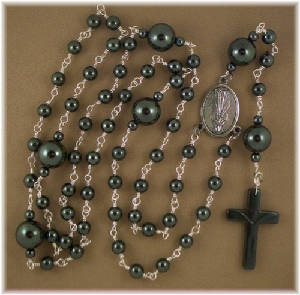
36. The traditional aid used for the recitation of the Rosary is
the set of beads. At the most superficial level, the beads often become a simple counting mechanism to mark the succession
of Hail Marys. Yet they can also take on a symbolism which can give added depth to contemplation.
Here the first thing to note is the way the beads converge upon the Crucifix, which
both opens and closes the unfolding sequence of prayer. The life and prayer of believers is centred upon Christ. Everything
begins from him, everything leads towards him, everything, through him, in the Holy Spirit, attains to the Father.
As a counting mechanism, marking the progress of the prayer, the
beads evoke the unending path of contemplation and of Christian perfection. Blessed Bartolo Longo saw them also as a "chain"
which links us to God. A chain, yes, but a sweet chain; for sweet indeed is the bond to God who is also our Father. A "filial"
chain which puts us in tune with Mary, the "handmaid of the Lord" (Lk 1:38) and, most of all, with Christ himself,
who, though he was in the form of God, made himself a "servant" out of love for us (Phil 2:7).
A fine way to expand the symbolism of the beads is to let them remind us of our many
relationships, of the bond of communion and fraternity which unites us all in Christ.
The opening and closing
37.At present, in different parts of the Church, there are many
ways to introduce the Rosary. In some places, it is customary to begin with the opening words of Psalm 70: "O God, come
to my aid; O Lord, make haste to help me", as if to nourish in those who are praying a humble awareness of their own
insufficiency. In other places, the Rosary begins with the recitation of the Creed, as if to make the profession of faith
the basis of the contemplative journey about to be undertaken. These and similar customs, to the extent that they prepare
the mind for contemplation, are all equally legitimate. The Rosary is then ended with a prayer for the intentions of the Pope,
as if to expand the vision of the one praying to embrace all the needs of the Church. It is precisely in order to encourage
this ecclesial dimension of the Rosary that the Church has seen fit to grant indulgences to those who recite it with the required
dispositions.
If prayed in this way, the Rosary truly
becomes a spiritual itinerary in which Mary acts as Mother, Teacher and Guide, sustaining the faithful by her powerful intercession.
Is it any wonder, then, that the soul feels the need, after saying this prayer and experiencing so profoundly the motherhood
of Mary, to burst forth in praise of the Blessed Virgin, either in that splendid prayer the Salve Regina or in the Litany
of Loreto? This is the crowning moment of an inner journey which has brought the faithful into living contact with the mystery
of Christ and his Blessed Mother.
Distribution over
time
38. The Rosary can be recited in full every
day, and there are those who most laudably do so. In this way it fills with prayer the days of many a contemplative, or keeps
company with the sick and the elderly who have abundant time at their disposal. Yet it is clear - and this applies all the
more if the new series of mysteria lucis is included - that many people will not be able to recite more than a part of the
Rosary, according to a certain weekly pattern. This weekly distribution has the effect of giving the different days of the
week a certain spiritual "colour", by analogy with the way in which the Liturgy colours the different seasons of
the liturgical year.
According to current practice,
Monday and Thursday are dedicated to the "joyful mysteries", Tuesday and Friday to the "sorrowful mysteries",
and Wednesday, Saturday and Sunday to the "glorious mysteries". Where might the "mysteries of light" be
inserted? If we consider that the "glorious mysteries" are said on both Saturday and Sunday, and that Saturday has
always had a special Marian flavour, the second weekly meditation on the "joyful mysteries", mysteries in which
Mary's presence is especially pronounced, could be moved to Saturday. Thursday would then be free for meditating on the "mysteries
of light".
This indication is not intended to
limit a rightful freedom in personal and community prayer, where account needs to be taken of spiritual and pastoral needs
and of the occurrence of particular liturgical celebrations which might call for suitable adaptations. What is really important
is that the Rosary should always be seen and experienced as a path of contemplation. In the Rosary, in a way similar to what
takes place in the Liturgy, the Christian week, centred on Sunday, the day of Resurrection, becomes a journey through the
mysteries of the life of Christ, and he is revealed in the lives of his disciples as the Lord of time and of history.
CONCLUSION
"Blessed Rosary
of Mary, sweet chain linking us to God"
39. What has been said so far makes abundantly clear the richness of this traditional prayer, which has the simplicity
of a popular devotion but also the theological depth of a prayer suited to those who feel the need for deeper contemplation.
The Church has always attributed particular efficacy to this prayer,
entrusting to the Rosary, to its choral recitation and to its constant practice, the most difficult problems. At times when
Christianity itself seemed under threat, its deliverance was attributed to the power of this prayer, and Our Lady of the Rosary
was acclaimed as the one whose intercession brought salvation.
Today I willingly entrust to the power of this prayer - as I mentioned at the beginning - the cause of peace in the
world and the cause of the family.
Peace
40. The grave challenges
confronting the world at the start of this new Millennium lead us to think that only an intervention from on high, capable
of guiding the hearts of those living in situations of conflict and those governing the destinies of nations, can give reason
to hope for a brighter future.
The Rosary is by its
nature a prayer for peace, since it consists in the contemplation of Christ, the Prince of Peace, the one who is "our
peace" (Eph 2:14). Anyone who assimilates the mystery of Christ - and this is clearly the goal of the Rosary - learns
the secret of peace and makes it his life's project. Moreover, by virtue of its meditative character, with the tranquil succession
of Hail Marys, the Rosary has a peaceful effect on those who pray it, disposing them to receive and experience in their innermost
depths, and to spread around them, that true peace which is the special gift of the Risen Lord (cf. Jn 14:27; 20.21).
The Rosary is also a prayer for peace because of the fruits of
charity which it produces. When prayed well in a truly meditative way, the Rosary leads to an encounter with Christ in his
mysteries and so cannot fail to draw attention to the face of Christ in others, especially in the most afflicted. How could
one possibly contemplate the mystery of the Child of Bethlehem, in the joyful mysteries, without experiencing the desire to
welcome, defend and promote life, and to shoulder the burdens of suffering children all over the world? How could one possibly
follow in the footsteps of Christ the Revealer, in the mysteries of light, without resolving to bear witness to his "Beatitudes"
in daily life? And how could one contemplate Christ carrying the Cross and Christ Crucified, without feeling the need to act
as a "Simon of Cyrene" for our brothers and sisters weighed down by grief or crushed by despair? Finally, how could
one possibly gaze upon the glory of the Risen Christ or of Mary Queen of Heaven, without yearning to make this world more
beautiful, more just, more closely conformed to God's plan?
In a word, by focusing our eyes on Christ, the Rosary also makes us peacemakers in the world. By its nature as an
insistent choral petition in harmony with Christ's invitation to "pray ceaselessly" (Lk 18:1), the Rosary allows
us to hope that, even today, the difficult "battle" for peace can be won. Far from offering an escape from the problems
of the world, the Rosary obliges us to see them with responsible and generous eyes, and obtains for us the strength to face
them with the certainty of God's help and the firm intention of bearing witness in every situation to "love, which binds
everything together in perfect harmony" (Col 3:14).
The
family: parents...
41. As a prayer for peace, the
Rosary is also, and always has been, a prayer of and for the family. At one time this prayer was particularly dear to Christian
families, and it certainly brought them closer together. It is important not to lose this precious inheritance. We need to
return to the practice of family prayer and prayer for families, continuing to use the Rosary.
In my Apostolic Letter Novo Millennio Ineunte I encouraged the celebration of the Liturgy
of the Hours by the lay faithful in the ordinary life of parish communities and Christian groups; I now wish to do the same
for the Rosary. These two paths of Christian contemplation are not mutually exclusive; they complement one another. I would
therefore ask those who devote themselves to the pastoral care of families to recommend heartily the recitation of the Rosary.
The family that prays together stays together. The Holy Rosary,
by age-old tradition, has shown itself particularly effective as a prayer which brings the family together. Individual family
members, in turning their eyes towards Jesus, also regain the ability to look one another in the eye, to communicate, to show
solidarity, to forgive one another and to see their covenant of love renewed in the Spirit of God.
Many of the problems facing contemporary families, especially in economically developed
societies, result from their increasing difficulty in communicating. Families seldom manage to come together, and the rare
occasions when they do are often taken up with watching television. To return to the recitation of the family Rosary means
filling daily life with very different images, images of the mystery of salvation: the image of the Redeemer, the image of
his most Blessed Mother. The family that recites the Rosary together reproduces something of the atmosphere of the household
of Nazareth: its members place Jesus at the centre, they share his joys and sorrows, they place their needs and their plans
in his hands, they draw from him the hope and the strength to go on.
... and children
42. It is also beautiful
and fruitful to entrust to this prayer the growth and development of children. Does the Rosary not follow the life of Christ,
from his conception to his death, and then to his Resurrection and his glory? Parents are finding it ever more difficult to
follow the lives of their children as they grow to maturity. In a society of advanced technology, of mass communications and
globalization, everything has become hurried, and the cultural distance between generations is growing ever greater. The most
diverse messages and the most unpredictable experiences rapidly make their way into the lives of children and adolescents,
and parents can become quite anxious about the dangers their children face. At times parents suffer acute disappointment at
the failure of their children to resist the seductions of the drug culture, the lure of an unbridled hedonism, the temptation
to violence, and the manifold expressions of meaninglessness and despair.
To pray the Rosary for children, and even more, with children, training them from their earliest years to experience
this daily "pause for prayer" with the family, is admittedly not the solution to every problem, but it is a spiritual
aid which should not be underestimated. It could be objected that the Rosary seems hardly suited to the taste of children
and young people of today. But perhaps the objection is directed to an impoverished method of praying it. Furthermore, without
prejudice to the Rosary's basic structure, there is nothing to stop children and young people from praying it - either within
the family or in groups - with appropriate symbolic and practical aids to understanding and appreciation. Why not try it?
With God's help, a pastoral approach to youth which is positive, impassioned and creative - as shown by the World Youth Days!
- is capable of achieving quite remarkable results. If the Rosary is well presented, I am sure that young people will once
more surprise adults by the way they make this prayer their own and recite it with the enthusiasm typical of their age group.
The Rosary, a treasure
to be rediscovered
43. Dear brothers
and sisters! A prayer so easy and yet so rich truly deserves to be rediscovered by the Christian community. Let us do so,
especially this year, as a means of confirming the direction outlined in my Apostolic Letter Novo Millennio Ineunte, from
which the pastoral plans of so many particular Churches have drawn inspiration as they look to the immediate future.
I turn particularly to you, my dear Brother Bishops, priests and
deacons, and to you, pastoral agents in your different ministries: through your own personal experience of the beauty of the
Rosary, may you come to promote it with conviction.
I
also place my trust in you, theologians: by your sage and rigorous reflection, rooted in the word of God and sensitive to
the lived experience of the Christian people, may you help them to discover the Biblical foundations, the spiritual riches
and the pastoral value of this traditional prayer.
I
count on you, consecrated men and women, called in a particular way to contemplate the face of Christ at the school of Mary.
I look to all of you, brothers and sisters of every state of life,
to you, Christian families, to you, the sick and elderly, and to you, young people: confidently take up the Rosary once again.
Rediscover the Rosary in the light of Scripture, in harmony with the Liturgy, and in the context of your daily lives.
May this appeal of mine not go unheard! At the start of the twenty-fifth
year of my Pontificate, I entrust this Apostolic Letter to the loving hands of the Virgin Mary, prostrating myself in spirit
before her image in the splendid Shrine built for her by Blessed Bartolo Longo, the apostle of the Rosary. I willingly make
my own the touching words with which he concluded his well-known Supplication to the Queen of the Holy Rosary: "O Blessed
Rosary of Mary, sweet chain which unites us to God, bond of love which unites us to the angels, tower of salvation against
the assaults of Hell, safe port in our universal shipwreck, we will never abandon you. You will be our comfort in the hour
of death: yours our final kiss as life ebbs away. And the last word from our lips will be your sweet name, O Queen of the
Rosary of Pompei, O dearest Mother, O Refuge of Sinners, O Sovereign Consoler of the Afflicted. May you be everywhere blessed,
today and always, on earth and in heaven".
From the Vatican, on the 16th day of October in the year 2002, the beginning of the twenty- fifth year of my
Pontificate.