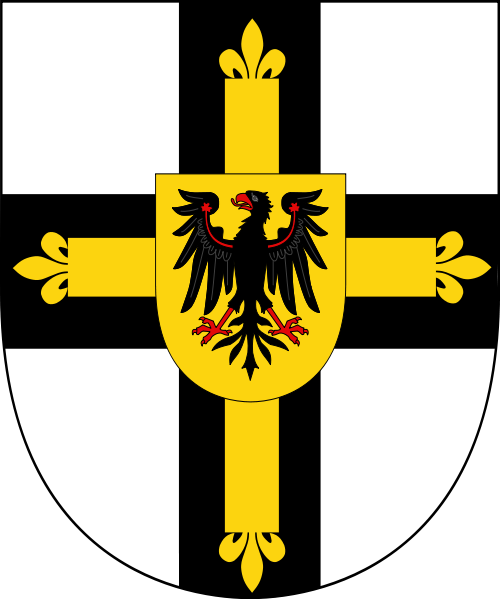
The Order of the Teutonic Knights of
St. Mary's Hospital in Jerusalem - 1190
The German Order of the Teutonic Knights of Christ in Jerusalem
Orden der Brüder vom Deutschen Haus St. Mariens
in Jerusalem
+ Helfen -
Wehren - Heilen + Help - Defend - Heal +
The Livonian
Brothers of the Sword
Fratres
militiæ Christi Livoniae
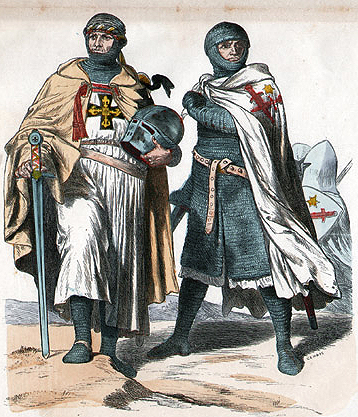
Bishop Albert of Riga founded the military order of the Livonian Brothers of the Sword (Latin: Fratres militiæ
Christi Livoniae, German: Schwertbrüderorden) in 1202; Pope Innocent III sanctioned the establishment in 1204. The membership
of the order comprised German "warrior monks". Alternative names of the Order include the Christ Knights, Sword
Brethren, and The Militia of Christ of Livonia. Following their defeat by the
Samogitians and Semigalians in the Battle of Schaulen (Saule) in 1236, the surviving Brothers merged into the Teutonic Order
as an autonomous branch and became known as the Livonian Order.
Albert, Bishop
of Riga (or Prince-Bishop of Livonia), founded the Brotherhood in 1202 to aid the Bishopric of Livonia in the conversion of
the pagan Livonians, Latgalians and Selonians living across the ancient trade routes from the Gulf of Riga eastwards. From
its foundation, the undisciplined Order tended to ignore its supposed vassalage to the bishops. In 1218 Albert asked King
Valdemar II of Denmark for assistance, but Valdemar instead arranged a deal with the Brotherhood and conquered the northern
Estonia (now known as Danish Estonia) for Denmark.
The Brotherhood had its headquarters at Fellin (Viljandi) in present-day Estonia, where the
walls of the Master's castle still stand. Other strongholds included Wenden (Cēsis), Segewold (Sigulda) and Ascheraden
(Aizkraukle). The commanders of Fellin, Goldingen (Kuldīga), Marienburg (Alūksne), Reval (Tallinn), and the bailiff
of Weißenstein (Paide) belonged to the five-member entourage of the Order's Master. Pope Gregory IX asked the Brothers to defend Finland from the Novgorodian attacks in his letter of November 24,
1232. However, no known information regarding the knights' possible activities in Finland has survived. (Sweden eventually
conquered Finland following the Second Swedish Crusade in 1249.)
The 1241 Treaty between Livonian Order, Bishopric of
Ösel-Wiek
and Oeselians at National Archives of Sweden
The
Order was decimated in the Battle of Schaulen (Saule) in 1236 against Lithuanians and Semigallians. This disaster led the
surviving Brothers to become incorporated into the Order of Teutonic Knights in the following year, and from that point on
they became known as the Livonian Order. They continued, however, to function in all respects (rule, clothing and policy)
as an autonomous branch of the Teutonic Order, headed by their own Master (himself de jure subject to the Teutonic Order's
Grand Master).
The
Masters of The Livonian Order
* Wenno (von Rohrbach) 1204-1209
* Volkwin (Schenk von Winterstein) 1209-1236