Saint Mary - Blessed Virgin Mary - Mother of Jesus Christ
Mary (Aramaic, Hebrew: מרים, Maryām, Miriam; Arabic:مريم, Maryam),
commonly referred to as "Saint Mary", "Mother Mary", the "Virgin Mary", the "Blessed Virgin
Mary", or "Mary, Mother of Jesus", was a Jewish woman of Nazareth in Galilee. She is identified in the New
Testament and in Islam as the mother of Jesus through divine intervention.[Mt 1:16,18-25] [Lk 1:26-56] [2:1-7]
The canonical gospels of Matthew and Luke describe Mary as a virgin
(Greek παρθένος, parthénos). Christians and Muslims believe that she conceived
her son miraculously by the agency of the Holy Spirit. This took place when she was already betrothed to Saint Joseph and
was awaiting the concluding rite of marriage, the formal home-taking ceremony. She married Joseph and accompanied him to Bethlehem,
where Jesus was born. In keeping with Jewish custom, the betrothal would have taken place when she was around 12, and the
birth of Jesus about a year later.
The New Testament
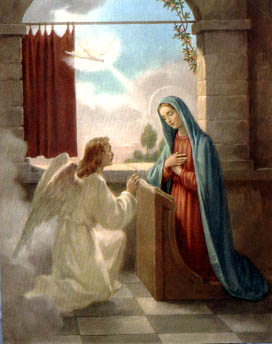
begins its account of Mary's life with the Annunciation, when the angel Gabriel appeared to her and announced her divine selection
to be mother of Jesus. Church tradition and early non-biblical writings state that her parents were an elderly couple, Saint
Joachim and Saint Anne. The Bible records Mary's role in key events of the life of Jesus from his conception to his Ascension.
Apocryphal writings tell of her subsequent death and bodily assumption into heaven.
Christians of the Catholic Church, the Eastern Orthodox Church, Oriental Orthodox Church, and the
Anglican Communion believe that Mary, as mother of Jesus, is the Mother of God (Μήτηρ Θεοῦ)
and the Theotokos, literally Birthgiver of God. Mary has been an object of veneration in Christianity since the Apostolic
Age. Throughout the ages she has been a favorite subject in Christian art, music, and literature.
There is significant diversity in the Marian beliefs and devotional practices of major
Christian traditions. The Catholic Church has a number of Marian dogmas, such as the Immaculate Conception and the Assumption.
Catholics refer to her as Our Lady and venerate her as the Queen of Heaven and Mother of the Church; most Protestants do not
share these beliefs.
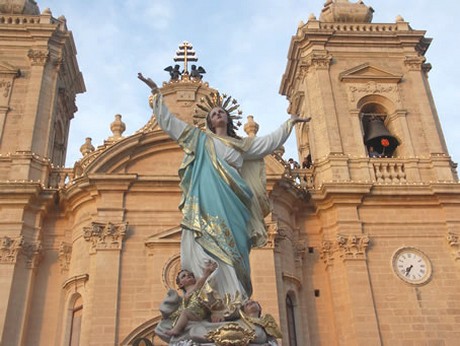
Family and Early life 0f Mary
The New Testament tells little of Mary's early history. Early non-biblical
writings name her parents as Joachim and Anne. However, in the canonical New Testament the gospel of Luke suggests that Mary's
father to be Heli the son of Matthat, although many argue that the genealogy is of Joseph's family.[Lk 3:23]
In Luke 3:23 the words "as was supposed" are used in
the King James translation. The Koine Greek preceding the translation "as was supposed" is νομίζω
pronounced nom-i-zo meaning practice or consider coming from the root word νόμος pronounced nom'-os
meaning law. Here Heli is shown as the father-in-law or according to practice of the law of Joseph, the husband of Mary. This
is in staunch contrast to Matthew 1:16 which speaks of Joseph's natural father as being Jacob.
Mary was a relative of Elizabeth, wife of the priest Zechariah of the priestly division
of Abijah, who was herself part of the lineage of Aaron and so of the tribe of Levi.[16]:p.134 [Lk 1:5] [1:36] In spite of
this, some speculate that Mary, like Joseph to whom she was betrothed, was of the House of David and so of the tribe of Judah,
and that the genealogy presented in Luke was hers, while Joseph's is given in Matthew.
She resided at Nazareth in Galilee, presumably with her parents and during her betrothal-the first
stage of a Jewish marriage-the angel Gabriel announced to her that she was to be the mother of the promised Messiah by conceiving
him through the Holy Spirit. When Joseph was told of her conception in a dream by "an angel of the Lord", he was
surprised; but the angel told him to be unafraid and take her as his wife, which Joseph did, thereby formally completing the
wedding rites.[Mt 1:18-25]
Since the angel Gabriel
had told Mary (according to Luke)[1:19] that Elizabeth, having previously been barren, was now miraculously pregnant, Mary
hurried to visit Elizabeth, who was living with her husband Zechariah in a city of Judah "in the hill country".[Lk
1:39] Once Mary arrived at the house and greeted Elizabeth, Elizabeth proclaimed Mary as "the mother of [her] Lord",
and Mary recited a song of thanksgiving commonly known as the Magnificat from its first word in Latin.[Lk 1:46-56] After three
months, Mary returned to her house.[Lk 1:56-57] According to the Gospel of Luke, a decree of the Roman emperor Augustus required
that Joseph and his betrothed should proceed to Bethlehem for a census. While they were there, Mary gave birth to Jesus; but
because there was no place for them in the inn, she had to use a manger as a cradle.[16]:p.14 [Lk 2:1ff] After eight days,
the boy was circumcised according to Jewish law. He was named Jesus in accordance with the instructions that the "angel
of the Lord" had given to Joseph after the Annunciation to Mary.[Mt 1:21] [Lu 1:31] These customary ceremonies were followed
by Jesus' presentation to the Lord at the Temple in Jerusalem in accordance with the law for firstborn males, then the visit
of the Magi, the family's flight into Egypt, their return after the death of King Herod the Great about 2 or 1 BC and taking
up residence in Nazareth. [Mt 2]
Mary in the life of Jesus
Mary is involved in the only event in Jesus' adolescent life that
is recorded in the New Testament. At the age of twelve Jesus, having become separated from his parents on their return journey
from the Passover celebration in Jerusalem, was found among the teachers in the temple. :p.210 [Lk 2:41-52]
After Jesus' baptism by John the Baptist and his temptations by the devil in the desert,
Mary was present when, at her intercession, Jesus worked his first public miracle during the marriage in Cana by turning water
into wine.[Jn 2:1-11] Subsequently there are events when Mary is present along with James, Joseph, Simon, and Judas, called
Jesus' brothers, and unnamed "sisters". [Mt 1:24-25] [12:46] [13:54-56] [27:56] [Mk 3:31] [6:3] [15:40] [16:1] [Jn
2:12] [7:3-5] [Gal 1:19] [Ac 1:14] These passages have been used to challenge the doctrine of the perpetual virginity of Mary,
however both Catholic and Orthodox churches interpret the words commonly translated "brother" and "sister"
as actually meaning close relatives (see Perpetual virginity). There is also an incident in which Jesus is sometimes interpreted
as rejecting his family. "And his mother and his brothers arrived, and standing outside, they sent in a message asking
for him[Mk 3:21] ... And looking at those who sat in a circle around him, Jesus said, 'These are my mother and my brothers.
Whoever does the will of God is my brother, and sister, and mother. [3:31-35]
Mary is also depicted as being present during the crucifixion standing near "the disciple
whom Jesus loved" along with Mary of Clopas and Mary Magdalene,[Jn 19:25-26] to which list Matthew 27:56 adds "the
mother of the sons of Zebedee", presumably the Salome mentioned in Mark 15:40. This representation is called a Stabat
Mater. Mary, cradling the dead body of her Son, while not recorded in the Gospel accounts, is a common motif in art, called
a "pietà" or "pity".
After the Ascension of Jesus
In Acts 1:26, especially v. 14, Mary is the only one to be mentioned
by name other than the twelve apostles and the candidates of about 120 people gathered, after the Ascension, in the Upper
Room on the occasion of the election of Matthias to the vacancy of Judas. (Though it is said that "the women" and
Jesus' brothers were there as well, their names are not given.) Some also consider the "chosen lady" mentioned in
2 John 1:1 as Mary. From this time, she disappears from the biblical accounts, although it is held by Catholics that she is
again portrayed as the heavenly woman of Revelation.[Rev 12:1]
Her death is not recorded in scripture. However, Catholic and Orthodox tradition and doctrine have her assumed (taken
bodily) into Heaven. Belief in the corporeal assumption of Mary is universal to Catholicism, in both Eastern and Western Catholic
Churches, as well as the Eastern Orthodox Church, Coptic Churches, and parts of the Anglican Communion and Continuing Anglican
Churches.
Later Christian Writings and
Traditions
According to the apocryphal
Gospel of James Mary was the daughter of Saint Joachim and Saint Anne. Before Mary's conception Anna had been barren. Mary
was given to service as a consecrated virgin in the Temple in Jerusalem when she was three years old, much like Hannah took
Samuel to the Tabernacle as recorded in the Old Testament.
According to Sacred Tradition, Mary died surrounded by the apostles (in either Jerusalem or Ephesus) between three
days and 24 years after Christ's ascension. When the apostles later opened her tomb, they found it to be empty and they concluded
that she had been assumed into Heaven. Mary's Tomb, an empty tomb in Jerusalem, is attributed to Mary. The Roman Catholic
Church teaches Mary's assumption, but does not teach that she necessarily died.
The House of the Virgin Mary near Ephesus in Turkey is traditionally considered the place where
Mary lived until her assumption. The Gospel of John states that Mary went to live with the Disciple whom Jesus loved,[Jn 19:27]
identified as John the Evangelist. Irenaeus and Eusebius of Caesarea wrote in their histories that John later went to Ephesus,
which may provide the basis for the early belief that Mary also lived in Ephesus with John.
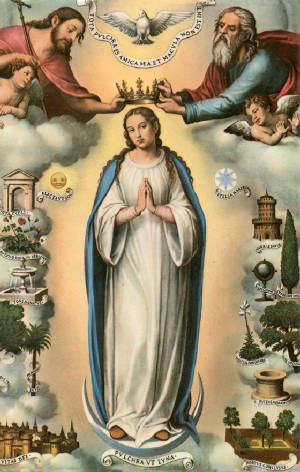
Christian Devotion
Christian devotion to Mary goes back to the 2nd century and predates
the emergence of a specific Marian liturgical system in the 5th century, following the First Council of Ephesus in 431. The
Council itself was held at a church in Ephesus which had been dedicated to Mary about a hundred years before. In Egypt the
veneration of Mary had started in the 3rd century and the term Theotokos was used by Origen, the Alexandrian Father of the
Church.
The earliest known Marian prayer (the Sub
tuum praesidium, or Beneath Thy Protection) is from the 3rd century (perhaps 270), and its text was rediscovered in 1917 on
a papyrus in Egypt. Following the Edict of Milan in 313, by the 5th century artistic images of Mary began to appear in public
and larger churches were being dedicated to Mary, e.g. S. Maria Maggiore in Rome.
Over the centuries, devotion and veneration to Mary has varied greatly among Christian traditions.
For instance, while Protestants show scant attention to Marian prayers or devotions, of all the saints whom the Orthodox venerate,
the most honored is Mary, who is considered "more honorable than the Cherubim and more glorious than the Seraphim."
Orthodox theologian Sergei Bulgakov wrote: "Love and veneration
of the Blessed Virgin Mary is the soul of Orthodox piety. A faith in Christ which does not include his mother is another faith,
another Christianity from that of the Orthodox church."
Although the Catholics and the Orthodox may honor and venerate Mary, they do not view her as divine, nor do they
worship her. Catholics view Mary as subordinate to Christ, but uniquely so, in that she is seen as above all other creatures.
Similarly Theologian Sergei Bulgakov wrote that although the Orthodox view Mary as "superior to all created beings"
and "ceaslessly pray for her intercession" she is not considered a "substitute for the One Mediator" who
is Christ. "Let Mary be in honor, but let worship be given to the Lord" he wrote. Similarly, Catholics do not worship
Mary, but venerate her. Catholics use the term hyperdulia for Marian veneration rather than latria that applies to God and
dulia for other saints. The definition of the three level hierarchy of latria, hyperdulia and dulia goes back to the Second
Council of Nicaea in 787.
Devotions to artistic depictions
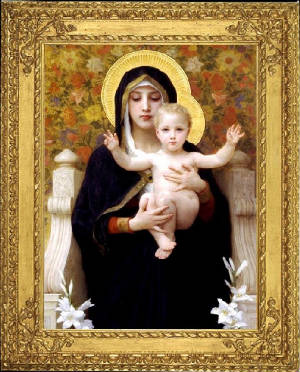
of Mary vary among Christian traditions. There is a long tradition of Roman Catholic Marian art and no image permeates Catholic
art as does the image of Madonna and Child. The icon of the Virgin is without doubt the most venerated icon among the Orthodox.
Both Roman Catholics and the Orthodox venerate images and icons of Mary, given that the Second Council of Nicaea in 787 permitted
their veneration by Catholics with the understanding that those who venerate the image are venerating the reality of the person
it represents, and the 842 Synod of Constantinople established the same for the Orthodox. The Orthodox, however, only pray
to and venerate flat, two-dimensional icons and not three-dimensional statues.
The Anglican position towards Mary is in general more conciliatory than that of Protestants at
large and in a book he wrote about praying with the icons of Mary, Rowan Williams, the Archbishop of Canterbury said: "It
is not only that we cannot understand Mary without seeing her as pointing to Christ; we cannot understand Christ without seeing
his attention to Mary".
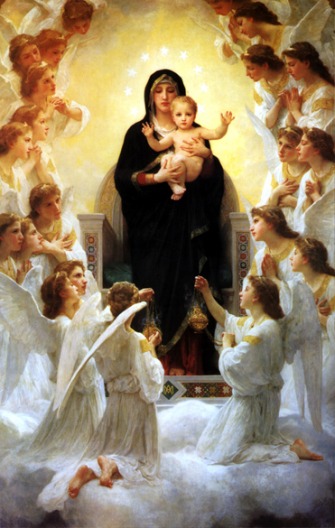
Titles of Mary
Titles to honor Mary or ask for her intercession are used by some
Christian traditions such as the Eastern Orthodox or Catholics, but not others, e.g. the Protestants. Common titles for Mary
include Mother of God (Theotokos), The Blessed Virgin Mary (also abbreviated to "BVM"), Our Lady (Notre Dame, Nuestra
Señora, Nossa Senhora, Madonna) and the Queen of Heaven (Regina Caeli).
Mary is referred to by the Eastern Orthodox Church, Oriental Orthodoxy, the Anglican Church, and
all Eastern Catholic Churches as Theotokos, a title recognized at the Third Ecumenical Council (held at Ephesus to address
the teachings of Nestorius, in 431). Theotokos (and its Latin equivalents, "Deipara" and "Dei genetrix")
literally means "Godbearer". The equivalent phrase "Mater Dei", (Mother of God) is more common in Latin
and so also in the other languages used in the Western Catholic Church, but this same phrase in Greek (Μήτηρ
Θεοῦ), in the abbreviated form of the first and last letter of the two words (ΜΡ ΘΥ),
is the indication attached to her image in Byzantine icons. The Council stated that the Church Fathers "did not hesitate
to speak of the holy Virgin as the Mother of God".
Some
titles have a Biblical basis, for instance the title Queen Mother has been given to Mary since she was the mother of Jesus,
who was sometimes referred to as the "King of Kings" due to his lineage of King David. The biblical basis for the
term Queen can be seen in the Gospel of Luke 1:32 and the Book of Isaiah 9:6, and Queen Mother from 1 Kings 2:19-20 and Jeremiah
13:18-19. Other titles have arisen from reported miracles, special appeals or occasions for calling on Mary, e.g. Our Lady
of Good Counsel, Our Lady of Navigators or Our Lady of Ransom who protects captives.
The three main titles for Mary used by the Orthodox are Theotokos, i.e., Mother of God (Greek Θεοτόκος),
Aeiparthenos, i.e. Ever Virgin (Greek ἀειπαρθὲνος), as confirmed
in the Fifth Ecumenical Council 553, and Panagia, i.e., All Holy (Greek Παναγία). A large
number of titles for Mary are used by Roman Catholics, and these titles have in turn given rise to many artistic depictions,
e.g. the title Our Lady of Sorrows has resulted in masterpieces such as Michelangelo's Pietà.
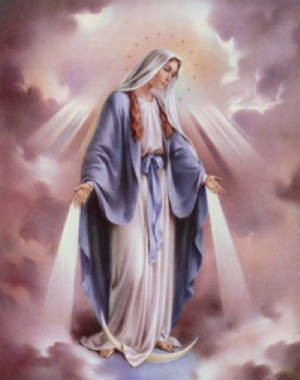
Marian feast days (includes
lists of feast days)
The earliest
feasts that relate to Mary grew out of the cycle of feasts that celebrated the Nativity of Jesus. Given that according to
the Gospel of Luke (Luke 2:22-40), forty days after the birth of Jesus, along with the Presentation of Jesus at the Temple
Mary was purified according to Jewish customs, the Feast of the Purification began to be celebrated by the 5th century, and
became the "Feast of Simeon" in Byzantium.
In
the 7th and 8th centuries four more Marian feasts were established in the Eastern Church. In the Western Church a feast dedicated
to Mary, just before Christmas was celebrated in the Churches of Milan and Ravenna in Italy in the 7th century. The four Roman
Marian feasts of Purification, Annunciation, Assumption and Nativity of Mary were gradually and sporadically introduced into
England by the 11th century.
Over time, the number
and nature of feasts (and the associated Titles of Mary) and the venerative practices that accompany them have varied a great
deal among diverse Christian traditions. Overall, there are significantly more titles, feasts and venerative Marian practices
among Roman Catholics than any other Christians traditions. Some such feasts relate to specific events, e.g. the Feast of
Our Lady of Victory was based on the 1571 victory of the Papal States in the Battle of Lepanto.
Differences in feasts may also originate from doctrinal issues - the Feast of the Assumption
is such an example. Given that there is no agreement among all Christians on the circumstances of the death, Dormition or
Assumption of Mary, the feast of assumption is celebrated among some denominations and not others. While the Catholic Church
celebrates the Feast of the Assumption on August 15, some Eastern Catholics celebrate it as Dormition of the Theotokos, and
may do so on August 28, if they follow the Julian calendar. The Eastern Orthodox also celebrate it as the Dormition of the
Theotokos, one of their 12 Great Feasts. Protestants do not celebrate this, or any other Marian feasts.
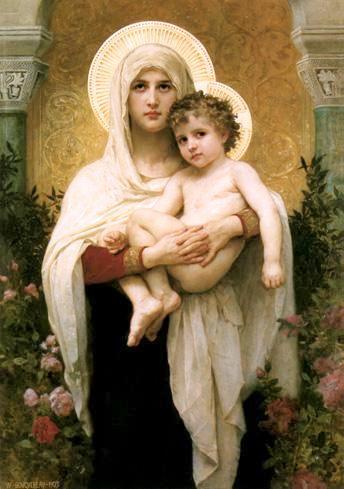
Christian Doctrines
There is significant diversity in the Marian doctrines accepted by various Christian
churches. The key Marian doctrines held in Christianity can be briefly outlined as follows:
* Mother of God: holds that Mary, as mother of Jesus is therefore Theotokos (God-bearer), or
Mother of God.
* Virgin birth of Jesus: states that Mary miraculously conceived Jesus by action of the Holy Spirit
while remaining a virgin.
* Dormition: the Orthodox understanding of the Assumption.
* Assumption: the doctrine
which states that Mary was taken bodily into Heaven either at, or before, her death.
* Immaculate Conception: states
that Mary herself was conceived without original sin.
* Perpetual Virginity: holds that Mary remained a virgin all
her life, even after the act of giving birth to Jesus.