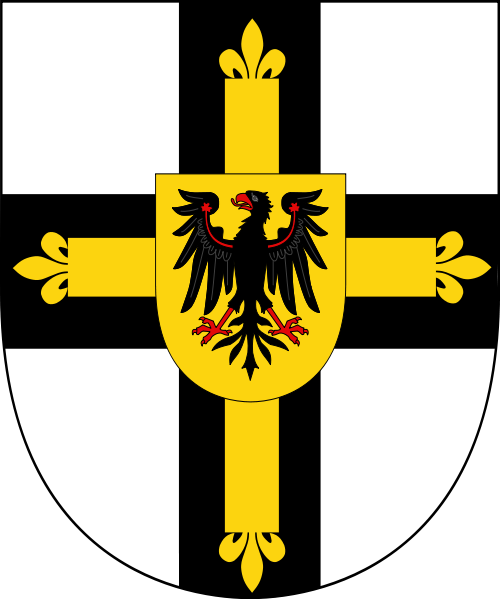
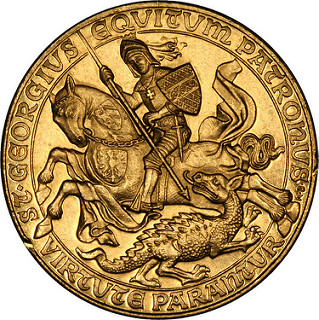
Saint George - Teutonic Order
Also known as Victory Bringer, Memorial 23rd April (Roman Catholic);
3rd November
(Russian Orthodox); fourth Sunday in June (Malta); third Sunday in July (Gozo) ,
Profile Soldier.
Martyr. That's all we know for sure. Several stories have been
attached to Saint George, the best known of which is
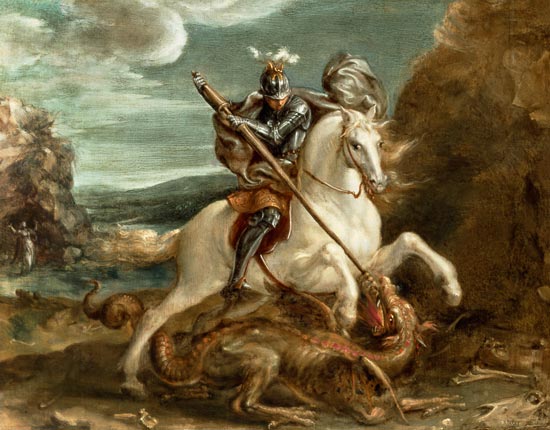
the Golden Legend. In it, a
dragon lived in a lake near Silena, Libya. Whole armies had gone up against this
fierce
creature, and had gone down in painful defeat. The monster ate two sheep
each day; when mutton was scarce, lots were
drawn in local villages, and maidens
were substituted for sheep. Into this country came Saint George. Hearing the story
on a day when a princess was to be eaten, he crossed himself, rode to battle against
the serpent, and killed it with
a single blow with his lance. George then held forth
with a magnificent sermon, and converted the locals. Given a large
reward by the king,
George distributed it to the poor, then rode away.

Due to his chivalrous behavior (protecting women,
fighting evil, dependence on faith
and might of arms, largesse to the poor), devotion to Saint George became popular
in
the Europe after the 10th century. In the 15th century his feast day was as popular
and important as Christmas.
Many of his areas of patronage have to do with life as a
knight on horseback. The celebrated Knights of the Garter are
actually Knights of the
Order of Saint George. The shrine built for his relics at Lydda, Palestine was a
popular
point of pilgrimage for centuries. One of the Fourteen Holy Helpers.
Died tortured and beheaded c.304 at Lydda, Palestine
.
The Patronage of Saint George
Amersfoort, Netherlands; Aragon; agricultural
workers; archers; armourers;
Beirut, Lebanon; Boy Scouts; butchers; Canada; Cappadocia; Catalonia; cavalry; chivalry;
Constantinople; Crusaders; England (by Pope Benedict XIV); equestrians; Ethiopia; farmers;
Ferrara, Italy; field hands;
field workers; Freiburg, Baden-Württemberg, Germany; Genoa,
Italy; Georgia; Germany; Gozo; Greece; Haldern, Germany;
Heide, Germany; herpes; horsemen;
horses; husbandmen; Istanbul; knights; lepers; leprosy; diocese of Limburg, Germany;
Lithuania; Malta; Modica, Sicily; Moscow, Russia; Nerola, Italy; Order of the Garter;
Palestine; Palestinian Christians;
plague; Portugal; Ptuj, Slovenia; Qormi, Malta; Riano,
Italy; riders; saddle makers; saddlers; Senj, Croatia; sheep;
shepherds; skin diseases;
skin rashes; soldiers; syphilis; Teutonic Knights; Venice, Italy; Victoria, Gozo, Malta.