The German House - Deutschhaus
- Mainz
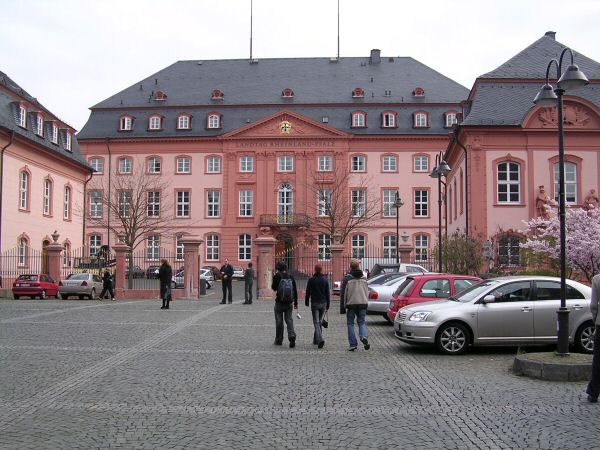
The Deutschhaus or Deutschordenskommende,
Mainz,
(German for "Commandry of the Teutonic Knights")
is the seat of the Rhineland-Palatinate Landtag.
The baroque palace was built from 1729-1740 for Franz Ludwig von
Pfalz-Neuburg, Prince-elector and Archbishop of Mainz 1729-1732.
Since he was at the same time Hochmeister of the Teutonic Knights,
he built the Deutschhaus
as his second residence for representative
purposes in his duties as Hochmeister in the immediate
neighborhood
of the Electoral Palace, his
other residence.
The building was constructed by Anselm Franz
Freiherr von Ritter zu
Groenesteyn in a style influenced by French Baroque architecture. It
consists of a main building
and two pavilions around a central court.
One of the pavilions contained a chapel with frescoes by Christoph
Thomas
Scheffler. Due to the Hochmeister's death in 1732, the building
was never used for its intended function as Hochmeister's
residence.
In the times of French occupation leading to the establishment of the
Republic of Mainz, it became the seat
of the Rhenish-German National
Convention. This earliest democratically elected parliament in Germany
first met
on March 17, 1793 in the Deutschhaus. On the next day, the
Convention declared Mainz and all of the territory between
Landau and
Bingen to be an independent state based on the principles of liberty
and egality, and the Convention's
president Andreas Joseph Hofmann
proclaimed the Rhenish-German Free State (Rheinisch-Deutscher Freistaat)
from
the balcony of the Deutschhaus. After this period had ended with
the French capitulation after the Siege of Mainz on
July 23, 1793, the
building was used by Archduke Charles, Duke of Teschen until the
territory was ceded to France
again in the Treaty of Campo Formio, and
the Deutschhaus became the administrative seat of the French département
Mont-Tonnerre. It was used as a palace by Napoleon during all of his 9
stays in Mainz, who planned to double the size
of the building and use
it as an imperial residence, as Mayence was intended to become one of
the bonnes villes
de l'Empire, the 36 most important cities of France.
In the aftermath of the Napoleonic Wars, the building
was used by the
Dukes of Hesse-Darmstadt, who obtained the territory of Mainz after the
Congress of Vienna. In 1870,
the building served as the headquarters
of the Prussian army in the early stages of the Franco-Prussian War.
During
World War II, the building was heavily damaged, especially in
the air raid of February 27, 1945, which destroyed most
of the city.
Of the Deutschhaus, only the exterior walls remained.
Reconstruction started after the Rhineland-Palatinate Landtag decided
to move from Koblenz to Mainz on May 28,
1950. It was completed in 1951,
and the new building was used for the first time for the constituting
session of
the newly elected Landtag on May 18, 1951. It has been used
as plenary building of the Landtag ever since. As the Deutschhaus
has
only very limited office space for the members of parliament, a new
office building for them was constructed
in 1999.