The History of the Germanic Tribes and Races
The Germanic Peoples (also called Teutonic in older literature)
are a
historical ethno-linguistic group, originating in Northern Europe and
identified by their use of the Indo-European
Germanic languages which
diversified out of Common Germanic in the course of the Pre-Roman Iron
Age. The descendants
of these peoples became, and in many areas
contributed to, the ethnic groups of North Western Europe: the Germans,
Norwegians, Swedish, Finland-Swedes, Danish, Faroese, English, Icelanders,
Austrians, Dutch and Flemish, and the inhabitants
of Switzerland, Alsace,
Lorraine (German: Lothringen) and Friesland on the continent.
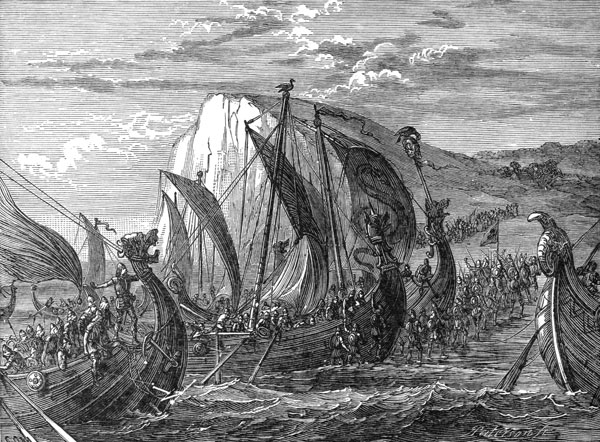
Migrating Germanic peoples spread throughout Europe in
Late Antiquity (300-600)
and the Early Middle Ages. Germanic languages became dominant along the Roman
borders
(Austria, Germany, Netherlands, Belgium and England), but in the rest
of the (western) Roman provinces, the Germanic
immigrants adopted Latin (Romance)
dialects. Furthermore, all Germanic peoples were eventually Christianized to
varying extents. The Germanic people played a large role in transforming the
Roman Empire into Medieval Europe.
The
History of the Term Germanic
Various etymologies for Latin Germani are possible.
As an adjective, germani is
simply the plural of the adjective
germanus (from germen, "seed" or "offshoot"),
which has the sense of "related"
or "kindred" or "authentic". According to Strabo,
the Romans introduced the
name Germani, because the Germanic tribes were the
authentic Celts (γνησίους
Γαλάτας; gnisíous Galátas). Alternatively, it may refer
from this use based on Roman experience of the Germanic tribes as allies of the Celts.
The ethnonym seems to be attested in the Fasti Capitolini inscription for the year 222,
DE GALLEIS INSVBRIBVS ET GERM(aneis), where it may simply refer to "related"
peoples, namely related to the Gauls. Furthermore, since the inscriptions were
erected only in 17 to 18 BCE, the
word may be a later addition to the text. Another
early mentioning of the name, this time by Poseidonios (writing around
80 BCE), is
also dubious, as it only survives in a quotation by Athenaios (writing around 190
CE); the mention of
Germani in this context was more likely inserted by Athenaios
rather than by Poseidonios himself. The writer who apparently
introduced the name
"Germani" into the corpus of classical literature is Julius Caesar. He uses Germani
in two slightly differing ways: one to describe any non-gaulic peoples of Germania,
and one to denote the Germani Cisrhenani,
a somewhat diffuse group of peoples in
north-eastern Gaul, who cannot clearly be identified as either Celtic or Germanic.
In this sense, Germani may be a loan from a Celtic exonym applied
to the Germanic
tribes, based on a word for "neighbour". Tacitus suggests that it might be from a
tribe
which changed its name after the Romans adapted it, but there is no evidence
for this. The suggestion deriving the name
from Gaulish term for "neighbour" invokes
Old Irish gair, Welsh ger, "near", Irish gearr, "cut,
short" (a short distance), from
a Proto-Celtic root *gerso-s, further related to ancient Greek chereion, "inferior"
and English gash. The Proto-Indo-European root could be of the form *khar-, *kher-,
*ghar-, *gher-, "cut",
from which also Hittite kar-, "cut", whence also Greek character.
Apparently, the Germanic tribes did not have a self-designation ("endonym") that
included all Germanic-speaking
people but excluded all non-Germanic people. Non-
Germanic peoples (primarily Celtic, Roman, Greek, the citizens of the
Roman Empire),
on the other hand, were called *walha- (this word lives forth in names such as Wales,
Welsh, Cornwall,
Walloons, Vlachs etc.). Yet, the name of the Suebi - which designated
a larger group of tribes and was used almost indiscriminately
with Germani in Caesar
- was possibly a Germanic equivalent of the Latin name (*swē-ba- "authentic").
The
Term of Teutonic or Deutsch
Trying
to identify a contemporary vernacular term and the associated nation
with a classical name, Latin writers from the 10th
century onwards used the
learnèd adjective teutonicus (originally derived from the Teutones) to refer
to
East Francia ("Regnum Teutonicum") and its inhabitants. This usage is
still partly present in modern English;
hence the English use of "Teutons"
in reference to the Germanic peoples in general besides the specific tribe
of the Teutons defeated at the Battle of Aquae Sextiae in 102 BCE.
The generic *þiuda- "people" occurs in many personal
names such as Thiud-reks
and also in the ethnonym of the Swedes from a cognate of Old English Sweo-ðēod
and Old Norse: Sui-þióð (see e.g. Sö Fv1948;289). Additionally, þiuda- appears
in Angel-ðēod
("Anglo-Saxon people") and Gut-þiuda ("Gothic people"). The
adjective derived from this noun,
*þiudiskaz, "popular", was later used with
reference to the language of the people in contrast to the
Latin language
(earliest recorded example 786). The word is continued in German Deutsch
(meaning German), English
"Dutch", Dutch Duits and Diets (the latter referring
to Dutch, the former meaning German) and Swedish/Danish/Norwegian
tysk
(meaning German).
The Classification of the Germanic Race
By the 1st century CE, the writings of Caesar, Tacitus and other
Roman era writers indicate a division of Germanic-speaking peoples
into tribal groupings centred on:
*......... the rivers Oder and Vistula/Weichsel (East Germanic
tribes),
*................................................... the lower Rhine river (Istvaeones),
* ................................................................the
river Elbe (Irminones),
* ...................................Jutland and the Danish islands (Ingvaeones).
The Sons of Mannus, Istvaeones, Irminones, and Ingvaeones are collectively
called West Germanic tribes. In addition, those Germanic people who remained
in Scandinavia are referred to as North
Germanic. These groups all developed
separate dialects, the basis for the differences among Germanic language down
to the present day. Detail of the Uppland Rune Inscription 871 (12th century)
The division of peoples into West Germanic, East Germanic, and North Germanic
is a modern
linguistic classification. Many Greek scholars only classified
Celts and Scythians in the Northwest and Northeast of
the Mediterranean and this
classification was widely maintained in Greek literature until Late Antiquity.
Latin-Greek
ethnographers (Tacitus, Pliny the Elder, Ptolemy, and Strabo)
mentioned in the first two centuries the names of peoples
they classified as
Germanic along the Elbe, the Rhine, and the Danube, the Vistula and on the Baltic
Sea. Tacitus
mentioned 40, Ptolemy 69 peoples. Classical ethnography applied the
name Suebi to many tribes in the first century.
It appeared that this native name
had all but replaced the foreign name Germanic. After the Marcomannic wars the
Gothic name steadily gained importance. Some of the ethnic names mentioned by the
ethnographers of the first two centuries
on the shores of the Oder and the Vistula
(Gutones, Vandali) reappear from the 3rd century on in the area of the lower
Danube
and north of the Carpathian Mountains. For the end of the 5th century the Gothic
name can be used - according
to the historical sources - for such different peoples
like the Goths in Gaul, Iberia and Italy, the Vandals in Africa,
the Gepids along the
Tisza and the Danube, the Rugians, Sciri and Burgundians, even the Iranian Alans.
These peoples were classified as Scyths and often deducted from the ancient Getae
(most important: Cassiodor / Jordanes,
Getica around 550).
The
Bronz Age
Regarding the question
of ethnic origins, evidence developed by archaeologists
and linguists suggests that a people or group of peoples sharing
a common
material culture dwelt in a region defined by the Nordic Bronze Age culture
between 1700 BCE and 600
BCE. The Germanic tribes then inhabited southern
Scandinavia and Schleswig, but subsequent Iron Age cultures of the
same region,
like Wessenstedt (800 to 600 BCE) and Jastorf, are also in consideration. The
change of Proto-Indo-European
to Proto-Germanic has been defined by the first
sound shift (or Grimm's law) and must have occurred when mutually intelligible
dialects or languages in a Sprachbund were still able to convey such a change
to the whole region. So far it has
been impossible to date this event conclusively.
The
precise interaction between these peoples is not known, however, they are tied
together and influenced by regional features
and migration patterns linked to
prehistoric cultures like Hügelgräber, Urnfield, and La Tene. A deteriorating
climate
in Scandinavia around 850 BCE to 760 BCE and a later and more rapid one around 650
BCE might have triggered
migrations to the coast of Eastern Germany and further towards
the Vistula. A contemporary northern expansion of Hallstatt
drew part of these peoples
into the Celtic hemisphere, including nordwestblock areas and the region of Elp culture
(1800 BCE to 800 BCE). At around this time, this culture became influenced by Hallstatt
techniques of how to extract
bog iron from the ore in peat bogs, ushering in the
The
Pre-Roman Iron Age
Archeological
evidence suggests a relatively uniform Germanic people were located at about 750 BCE from the Netherlands to the Vistula and
in Southern Scandinavia. In the west the coastal floodplains were populated for the first time, since in adjacent higher
grounds the population had increased and the soil became exhausted. At about 250 BCE, some expansion to the south had occurred
and five general groups can be distinguished: North Germanic in southern Scandinavia, excluding Jutland; North Sea Germanic,
along the North Sea and in Jutland; Rhine- Weser Germanic, along the middle Rhine and Weser; Elbe Germanic, along the middle
Elbe; and East Germanic, between the middle Oder and the Vistula. This concurs with linguistic evidence pointing at the development
of five linguistic groups, mutually linked into sets of two to four groups that shared linguistic innovations.
This period witnessed the advent of Celtic culture
of Hallstatt and La Tene signature in previous Northern Bronze Age territory, especially to the western extends. However,
some proposals suggest this Celtic superstrate was weak, while the general view in the Netherlands holds that this Celtic
influence did not involve intrusions at all and assume fashion and a local development from Bronze Age culture. It is generally
accepted such a Celtic superstratum was virtually absent to the East, featuring the Germanic Wessenstedt and Jastorf cultures.
The Celtic influence and contacts between Gaulish and early Germanic culture along the Rhine is assumed as the source of a
number of Celtic loanwords in Proto-Germanic.
Frankenstein
and Rowlands (1978), and Wells (1980) have suggested late Hallstatt trade contact to be a direct catalyst for the development
of an elite class that came into existence around northeastern France, the Middle Rhine region, and adjacent Alpine regions
(Collis 1984:41), culminating to new cultural developments and the advent of the classical Gaulish La Tene Culture The
development of La Tene culture extended to the north around 200 to 150 BCE, including the North German Plain, Denmark
and Southern Scandinavia:
"In
certain cremation graves, situated at some distance from other graves, Celtic metalwork appears: brooches and swords,
together with wagons, Roman cauldrons and drinking vessels. The area of these rich graves is the same as the places
where later (the first century CE) princely graves are found. A ruling class seems to have emerged, distinguished by
the possession of large farms and rich gravegifts such as weapons for the men and silver objects for the women, imported
earthenware and Celtic items."
The
first Germani in Roman ethnography cannot be clearly identified as either Germanic or Celtic in the modern ethno-linguistic
sense, and it has been generally held the traditional clear cut division along the Rhine between both ethnic groups was primarily
motivated by Roman politics. Caesar described the Eburones as a Germanic tribe on the Gallic side of the Rhine, and held other
tribes in the neigh bourhood as merely calling themselves of Germanic stock. Even though names like Eburones and Ambiorix
were Celtic and, archeologically, this area shows strong Celtic influences, the problem is difficult. Some 20th century
writers consider the possibility of a separate "Nordwestblock" identity of the tribes settled along the Rhine at
the time, assuming the arrival of a Germanic superstrate from the 1st century BCE and a subsequent "Germanization"
or language replacement through the "elite-dominance"model. However, immigration of Germanic Batavians from Hessen
in the northern extent of this same tribal region is, archeologically speaking, hardly noticeable and certainly did not populate
an exterminated country, very unlike Tacitus suggested. Here, probably due to the local indigenous pastoral way of life,
the acceptance of Roman culture turned out to be particularly slow and, contrary to expected, the indigenous culture
of the previous Eburones rather seems to have absorbed the intruding (Batavian) element, thus making it very hard to
define the real extents of the pre-Roman Germanic indigenous territories.
Germanic expansions during early Roman times are known only generally, but it is clear that the forebears of
the Goths were settled on the southern Baltic shore by 100 CE. The early Germanic tribes are assumed to have spoken
mutually intelligible dialects, in the sense that Germanic languages derive from a single earlier parent language. No written
records of such a parent language exists. From what we know of scanty early written material, by the fifth century CE
the Germanic languages were already "sufficiently different to render communication between the various peoples
impossible". Some evidence point to a common pantheon made up of several different chronological layers. However, as
for mythology only the Scandinavian one (see Germanic mythology) is sufficiently known. Some traces of common traditions
between various tribes are indicated by Beowulf and the Volsunga saga. One indication of their shared identity is their common
Germanic name for non-Germanic peoples, *walhaz (plural of *walhoz), from which the local names Welsh, Wallis, Walloon
and others were derived. An indication of an ethnic unity is the fact that the Romans knew them as one and gave
them a common name, Germani (this is the source of our German and Germanic, see Etymology above), although it was well
known for the Romans to give geographical rather than cultural names to peoples. The very extensive practice of cremation
deprives us of anthropological comparative material for the earliest periods to support claims of a longstanding ethnic
isolation of a common (Nordic) strain.
By the late 2nd century BCE, Roman authors recount, Gaul, Italy and Hispania were invaded
by migrating Germanic tribes. This culminated in military conflict with the armies of the Roman Republic, in particular
those of the Roman Consul Gaius Marius. Six decades later, Julius Caesar invoked the threat of such attacks as one justification
for his annexation of Gaul to Rome. As Rome expanded to the Rhine and Danube rivers, it incorporated many Celtic societies
into the Empire. The tribal homelands to the north and east emerged collectively in the records as Germania. The peoples
of this area were sometimes at war with Rome, but also engaged in complex and long-term trade relations, military alliances,
and cultural exchanges with Rome as well. The Cimbri and Teutoni incursions into Roman Italy were thrust back in 101
BCE. These invasions were written up by Caesar and others as presaging of a Northern danger for the Roman Republic,
a danger that should be controlled. In the Augustean period there was - as a result of Roman activity as far as the
Elbe River - a first definition of the "Germania magna": from Rhine and Danube in the West and South to the
Vistula and the Baltic Sea in the East and North.
Caesar's wars helped establish the term Germania. The initial purpose of the Roman campaigns was to protect
Transalpine Gaul by controlling the area between the Rhine and the Elbe. In 9 CE a revolt of their Germanic subjects headed
by the supposed Roman ally, Arminius, (along with his decisive defeat of Publius Quinctilius Varus and the destruction of
3 Roman legions in the surprise attack on the Romans at the Battle of the Teutoburg Forest) ended in the withdrawal
of the Roman frontier to the Rhine. At the end of the 1st century two provinces west of the Rhine called Germania inferior
and Germania superior were established. Important medieval cities like Aachen, Cologne, Trier, Mainz, Worms and Speyer were
part of these Roman provinces.
The Migration Period
During the 5th century CE, as the Western Roman Empire lost military strength
and political cohesion, numerous Germanic peoples, under pressure from population growth and invading Asian groups,
began migrating en masse in far and diverse directions, taking them to Great Britain and as far south through present
day Continental Europe to the Mediterranean and northern Africa. Over time, this wandering meant intrusions into other tribal
territories, and the ensuing wars for land escalated with the dwindling amount of unoccupied territory. Wandering tribes
then began staking out permanent homes as a means of protection. Much of this resulted in fixed settlements from which
many, under a powerful leader, expanded outwards. A defeat meant either scattering or merging with the dominant tribe, and
this continual process of assimilation was how nations were formed. In Denmark the Jutes merged with the Danes, in Sweden
the Geats merged with the Swedes. In England, the Angles merged with the Saxons and other groups (notably the Jutes),
as well as possibly absorbing a number of natives, to form the Anglo-Saxons.
A direct result of the Roman retreat was the
disappearance of imported products like ceramics and coins, and a return to virtually unchanged local Iron Age production
methods. According to recent views this has caused confusion for decades, and theories assuming the total abandonment
of the coastal regions to account for an archaeological time gap that never existed have been renounced. Instead, it has been
confirmed that the Frisian graves had been used without interruption between the 4th and 9th century CE and that inhabited
areas show continuity with the Roman period in revealing coins, jewellery and ceramics of the 5th century. Also, people continued
to live in the same three-aisled farmhouse, while to the east completely new types of buildings arose. More to the south,
in Belgium, archeological results of this period point to immigration from the north.

The
Germanic Peoples Role in the Fall of Rome
Some of the Germanic tribes are frequently credited in popular depictions of the decline of the
Roman Empire in the late 5th century. Professional historians and archaeologists have since the 1950s shifted their interpretations
in such a way that the Germanic peoples are no longer seen as invading a decaying empire but as being co-opted into helping
defend territory the central government could no longer adequately administer. Individuals and small groups from Germanic
tribes had long been recruited from the territories beyond the limes (i.e., the regions just outside the Roman Empire), and
some of them had risen high in the command structure of the army. Then the Empire recruited entire tribal groups under their
native leaders as officers. Assisting with defense eventually shifted into administration and then outright rule, as Roman
government passed into the hands of Germanic leaders. Odoacer, who deposed Romulus Augustulus, is the ultimate example.
The presence of successor states controlled
by a nobility from one of the Germanic tribes is evident in the 6th century - even in Italy, the former heart of the
Empire, where Odoacer was followed by Theodoric the Great, king of the Ostrogoths, who was regarded by Roman citizens and
Gothic settlers alike as legitimate successor to the rule of Rome and Italy.
The Early Middle Ages
The transition of the Migration period to the Middle
Ages proper takes place over the course of the second half of the 1st millennium. It is marked by the Christianization
of the Germanic peoples and the formation of stable kingdoms replacing the mostly tribal structures of the Migration period.
In continental Europe, this is the rise of Francia in the Merovingian period, eclipsing lesser kingdoms such as Alemannia.
In England, the Wessex hegemony as the nucleus of the unification of England, Scandinavia is in the Vendel period and
enters the extremely successful Viking Age, with expansion to Britain, Ireland and Iceland in the west and as far as Russia
and Greece in the east. The various Germanic tribal cultures begin their transformation into the larger nations of later history,
English, Norse and German, and in the case of Burgundy, Lombardy and Normandy blending into a Romano-Germanic culture.
A main element uniting Germanic societies is kingship,
in origin a sacral institution combining the functions of military leader, high priest, lawmaker and judge. Germanic monarchy
was elective, the king was elected by the free men from among elegible candidates of a family (OE cynn) tracing their ancestry
to the tribe's divine or semi-divine founder. In early Germanic society, the free men of property each ruled their own estate
and were subject to the king directly, without any intermediate hierarchy as in later feudalism. Free men without landed
property could swear fealty to a man of property who as their lord would then be responsible for their upkeep, including generous
feasts and gifts. This system of sworn retainers was central toearly Germanic society, and the loyalty of the retainer to
his lord was taken to replace his family ties.
Early Germanic law reflects a hierarchy of worth within the society of free men, reflected in the differences in
weregild. Among the Anglo-Saxons, a regular free man (a ceorl) had a weregild of 200 shillings (i.e. solidi or gold
pieces), classified as a twyhyndeman "200-man" for this reason, while a nobleman commanded a fee of six times that
amount (twelfhyndeman "1200-man"). Similarly, among the Alamanni the basic weregild for a free men was 200 shillings,
and the amount could be doubled or trebled according to the man's rank. Unfree serfs did not command a weregild, and
the recompense paid in the event of their death was merely for material damage, 15 shillings in the case of the Alamanni,
increased to 40 or 50 if the victim had been a skilled artisan.
The social hierarchy is not only reflected in the weregild due in the case of the violent or accidental death of
a man, but also in differences in fines for lesser crimes. Thus the fines for insults, injury, burglary or damage to property
differ depending on the rank of the injured party. They do not usually depend on the rank of the guilty party, although there
are some exceptions associated with royal privilege. Free women did not have a political station of their own but inherited
the rank of their father if unmarried, or their husband if married. The weregild or recompense due for the killing or
injuring of a woman is notably set at twice that of a man of the same rank in Alemannic law.
All freemen had the right to participate in general assemblies or things,
where disputes between freemen were addressed according to customary law. The king was bound to uphold ancestral law,
but was at the same time the source for new laws for cases not addressed in previous tradition. This aspect was the
reason for the creation of the various Germanic law codes by the kings following their conversion to Christianity: besides
recording inherited tribal law, these codes have the purpose of settling the position of the church and Christian clergy
within society, usually setting the weregilds of the members of the clerical hierarchy parallel to that of the existing hierarchy
of nobility, with the position of an archbishop mirroring that of the king.
In the case of a suspected crime, the accused could avoid punishment by presenting a fixed number
of free men (their number depending on the severity of the crime) prepared to swear an oath on his innocence. Failing this,
he could prove his innocence in a trial by combat. Corporeal or capital punishment for free men does not figure in the Germanic
law codes, and banishment appears to be the most severe penalty issued officially. This reflects that Germanic tribal law
did not have the scope of exacting revenge, which was left to the judgement of the family of the victim, but to settle damages
as fairly as possible once an involved party decided to bring a dispute before the assembly.
Traditional Germanic society is gradually
replaced by the system of estates and feudalism characteristic of the High Middle Ages in both the Holy Roman Empire and Anglo-Norman
England in the 11th to 12th centuries, to some extent under the influence of Roman law as an indirect result of Christianization,
but also because political structures had grown too large for the flat hierarchy of a tribal society. The same effect of political
centralization takes hold in Scandinavia slightly later, in the 12th to 13th century (Age of the Sturlungs, Consolidation
of Sweden, Civil war era in Norway), by the end of the 14th century culminating in the giant Kalmar Union. Elements of tribal
law, notably the wager of battle, nevertheless remained in effect throughout the Middle Ages, in the case of the Holy Roman
Empire until the establishment of the Imperial Chamber Court in the beginning German Renaissance. In the federalist
organization of Switzerland, where cantonal structures remained comparatively local, the Germanic thing survived into the
20th century in the form of the Landsgemeinde, albeit subject to federal law.
The Material Culture
Germanic settlements were typically small, rarely containing
much more than ten households, often less, and were usually located at clearings in the wood. Settlements remained of
a fairly constant size throughout the period. The buildings in these villages varied in form, but normally consisted
of farmhouses surrounded by smaller buildings such as granaries and other storage rooms. The universal building material was
timber. Cattle and humans usually lived together in the same house.
Although the Germans practiced both agriculture and husbandry, the latter was extremely important
both as a source of dairy products and as a basis for wealth and social status, which was measured by the size of an
individual's herd. The diet consisted mainly of the products of farming and husbandry and was supplied by hunting to
a very modest extent. Barley and wheat were the most common agricultural products and were used for baking a certain
flat type of bread as well as brewing beer. The fields were tilled with a light-weight wooden plow, although heavier models
also existed in some areas. Common clothing styles are known from the remarkably well-preserved corpses that have been found
in former marshes on several locations in Denmark, and included woolen garments and brooches for women and trousers and leather
caps formen. Other important small-scale industries were weaving, the manual production of basic pottery and, morerarely,
the fabrication of iron tools, especially weapons.
Julius Caesar describes the Germans in his Commentarii De Bello Gallico, though it is still a matter of debate
if he refers to Northern Celtic tribes or clearly identified German tribes."[The Germans] have neither Druids to
preside over sacred offices, nor do they pay great regard to sacrifices. They rank in the number of the gods those alone
whom they behold, and by whose instrumentality they are obviously benefited, namely, the sun, fire, and the moon; they have
not heard of the other deities even by report. Their whole life is occupied in hunting and in the pursuits of the military
art; from childhood they devote themselves to fatigue and hardships. Those who have remained chaste for the longest time,
receivethe greatest commendation among their people; they think that by this the growth is promoted, by this the physical
powers are increased and the sinews are strengthened. And to have had knowledge of a woman before the twentieth year they
reckon among the most disgraceful acts; of which matter there is no concealment, because they bathe promiscuously in
the rivers and [only] use skins or small cloaks of deer's hides, a large portion of the body being in consequence naked.
They do not pay much attention to agriculture, and
a large portion of their food consists in milk, cheese, and flesh; nor has any one a fixed quantity of land or his own individual
limits; but the magistrates and the leading men each year apportion to the tribes and families, who have united together,
as much land as, and in the place in which, they think proper, and the year after compel them to remove elsewhere. For this
enactment they advance many reasons-lest seduced by long-continued custom, they may exchange their ardor in the waging of
war for agriculture; lest they may be anxious to acquire extensive estates, and the more powerful drive the weaker from their
possessions; lest they construct their houses with too great a desire to avoid cold and heat; lest the desire of wealth spring
up, from which cause divisions and discords arise; and that they may keep the common people in a contented state of mind,
when each sees his own means placed on an equality with [those of] the most powerful."
While the Germanic peoples were slowly converted to Christianity by varying
means, many elements of the pre-Christian culture and indigenous beliefs remained firmly in place after the conversion
process, particularly in the more rural and distant regions. The Ostrogoths, Visigoths, and Vandals were Christianized
while they were still outside the bounds of the Empire; however, they converted to Arianism rather than to orthodox
Catholicism, and were soon regarded as heretics. The one great written remnant of the Gothic language is
a translation of portions of the Bible made by Ulfilas, the missionary who converted them. The Lombards were not converted
until after their entrance into the Empire, but received Christianity from Arian Germanic groups.
The Franks were converted directly from paganism to Catholicism without
an intervening time as Arians. Several centuries later, Anglo-Saxon and Frankish missionaries and warriors undertook
the conversion of their Saxon neighbours. A key event was the felling of Thor's Oak near Fritzlar by Boniface, apostle
of the Germans, in 723. Eventually, the conversion was forced by armed force, successfully completed by Charlemagne, in a
series of campaigns (the Saxon Wars), that also brought Saxon lands into the Frankish empire. Massacres, such as the Bloody
Verdict of Verden, were a direct result of this policy. In Scandinavia, Germanic paganism continued to dominate until
the 11th century in the form of Norse paganism, when it was gradually replaced by Christianity.
The
Post-migration Ethnogeneses
The
Germanic tribes of the Migration period had settled down by the Early Middle
Ages, the latest series of movements out
of Scandinavia taking place during the
Viking Age. The Goths and Vandals were linguistically assimilated to their Latin
(Italo-Western Romance) substrate populations (with the exception of the Crimean
Goths, who preserved their dialect
into the 18th century). Burgundians and
were assimilated into both Latin (French & Italian) and Germanic populations.
The Viking Age Norsemen split into an
Old East Norse and an Old West Norse group, which
further separated into Icelanders, Faroese and Norwegians on one hand,
and Swedes and
Danes on the other. Politically, the union between Norway and Sweden was dissolved in
1905, and
the Republic of Iceland was established in 1944. In Great Britain, Germanic
people coalesced into the Anglo-Saxon or
English people between the 8th and 10th centuries.

The
Viking Age
Norsemen
split into an Old East Norse and an Old West Norse group, which further separated into Icelanders, Faroese and Norwegians
on one hand, and Swedes and Danes on the other. Politically, the union between Norway and Sweden was dissolved in 1905,
and the Republic of Iceland was established in 1944. In Great Britain, Germanic people coalesced into the Anglo-Saxon
or English people between the 8th and 10th centuries.. The various Germanic Peoples of the Migrations period eventually
spread out over a vast expanse stretching from contemporary European Russia to Iceland and from Norway to North Africa.
The migrants had varying impacts in different regions. In many cases, the newcomers set themselves up as over-lords
of the pre-existing population. Over time, such groups underwent ethnogenesis, resulting in the creation of new cultural and
ethnic identities (such as the Franks and Galloromans becoming French). Thus many of the descendants of the ancient Germanic
Peoples do not speak Germanic languages, as they were to a greater or lesser degree assimilated into the cosmopolitan,
literate culture of the Roman world. Even where the descendants of Germanic Peoples maintained greater continuity with
their common ancestors, significant cultural and linguistic differences arose over time; as is strikingly illustrated
by the different identities of Christianized Saxon subjects of the Carolingian Empire and Pagan Scandinavian Vikings. More
broadly, early Medieval Germanic peoples were often assimilated into the walha substrate cultures of their subject populations.
Thus, the Burgundians of Burgundy, the Vandals of n Andalusia and the Visigoths of western France and eastern Iberia all lost
their Germanic identity and became part of Latin Europe. Likewise, the Franks of Western Francia form part of the ancestry
of the French people. Examples of assimilation during the Viking Age include the Norsemen settled in Normandy and on
the French Atlantic coast, and the societal elite in medieval Russia among whom many were the descendants of Slavified Norsemen
(a theory, however, contested by some Slavic scholars in the former Soviet Union, who name it the Normanist theory).
Conversely, the Germanic settlement of Britain
resulted in Anglo-Saxon, or English, displacement of and/or cultural assimilation of the indigenous culture, the Brythonic
speaking British culture causing the foundation of a new Kingdom, England. As in what became England, indigenous Brythonic
Celtic culture in some of the south-eastern parts of what became Scotland (approximately the Lothian and Borders region)
and areas of what became the Northwest of England (the kingdoms of Rheged, Elmet, etc) succumbed to Germanic influence c.600-800,
due to the extension of overlordshipand settlement from the Anglo-Saxon areas to the south. Between c. 1150 and c. 1400 most
of the Scottish Lowlands became English culturally and linquistically through immigration from England, France
and Flanders and from the resulting assimilation of native Gaelic-speaking Scots. The Scots language is the resulting Germanic
language still spoken in parts of Scotland and is very similar to the speech of the Northumbrians of northern England. Between
the 15th and 17th centuries Scots spread into Galloway,Carrick and parts of the Scottish Highlands, as well as into the Northern
Isles. The latter, Orkney and Shetland, though now part of Scotland, were nominally part of the Kingdom of Norway until the
15th century. A version of the Norse language was spoken there from the Viking invasions until replaced by Scots. Portugal
and Spain also had some measure of Germanic settlement, due to the Visigoths, the Suebi (Quadi and Marcomanni) and the
Buri, who settled permanently. The Vandals (Silingi and Hasdingi) were also present, before moving on to North Africa. Many
words of Germanic origin entered into the Spanish and Portuguese languages at this time and many more entered through
other avenues (often French) in the ensuing centuries (see: List of Spanish words of Germanic origin and List of Portuguese
words of Germanic origin).
Italy has also had a history of heavy Germanic
settlement. Germanic tribes such as the Visigoths, Vandals, and Ostrogoths had successfully invaded and sparsely settled Italy
in the 5th century. Most notably, in the 6th century, the Germanic tribe known as the Lombards entered and settled primarily
in the area known today as Lombardy. The Normans also conquered and ruled Sicily and parts of southern Italy for a time.
Crimean Gothic communities appear to have survived intact until the late 1700's, when many were deported by Catherine the
Great. Their language vanished by the 1800's. The territory of modern Germany
was divided between Germanic and Celtic speaking groups in the last centuries BCE. The parts south of the Germanic Limes came
under limited Latin influence in the early centuries CE, but were swiftly conquered by Germanic groups such as the Alemanni
after the fall of the Western Roman Empire. After the disappearance of Germanic ethnicities (tribes) in the High Middle Ages,
the cultural identity of Europe was built on the idea of Christendom as opposed to Islam (the "Saracens", and later
the "Turks"). The Germanic peoples of Roman historiography were lumped with the other agents of the "barbarian
invasions", the Alans and the Huns, as opposed to the civilized "Roman" identity of the Holy Roman Empire.
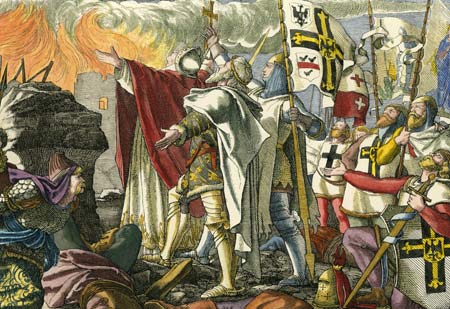
The Renaissance revived interest in pre-Christian Classical Antiquity
and only in a second phase in pre-Christian Northern Europe. Early modern publications dealing with Old Norse culture appeared
in the 16th century, e.g. Historia de gentibus septentrionalibus (Olaus Magnus, 1555) and the first edition of the 13th century
Gesta Danorum (Saxo Grammaticus), in 1514. Authors of the German Renaissance such as Johannes Aventinus discovered the Germanii
of Tacitus as the "Old Germans", whose virtue and unspoiled manhood, as it appears in the Roman accounts of noble
savagery, they contrast with the decadence of their own day. The pace of publication increased during the 17th century with
Latin translations of the Edda (notably Peder Resen's Edda Islandorum of 1665). The Viking revival of 18th century Romanticism
finally establishes the fascination with anything "Nordic". The beginning of Germanic philology proper begins in
the early 19th century, with Rasmus Rask's Icelandic Lexicon of 1814, and was in full bloom by the 1830s, with Jacob Grimm's
Deutsche Mythologie giving an extensive account of the reconstructed Germanic mythology and his Deutsches Wörterbuch
of Germanic etymology.
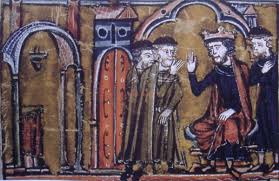
The development of Germanic studies as an academic discipline in the 19th century ran parallel
to the rise of nationalism in Europe and the search for national histories for the nascent nation states developing
after the end of the Napoleonic Wars. A "Germanic" national ethnicity offered itself for the unification of
Germany, contrasting the emerging German Empire with its neighboring rivals, the Welsche French Third Republic and the
"Slavic" Russian Empire. The nascent German ethnicity was consequently built on national myths of Germanic antiquity,
in instances such ast the Walhalla temple and the Hermann Heights Monument. These tendencies culminated in Pan-Germanism,
the Alldeutsche Bewegung aiming for the political unity of all of German-speaking Europe (all Volksdeutsche) into a Teutonic
nation state. Contemporary Romantic nationalism in Scandinavia placed more weight on the Viking Age, resulting in the movement
known as Scandinavism. The theories of race developed in the same period identified the Germanic peoples of the Migration
period as members of a Nordic race expanding at the expense of an Alpine race native to Central and Eastern Europe.

Alphabetic
List of The German Tribes
A
Adogit, Aelvaeones, Aeragnaricii, Ahelmil, Alamanni or
Alemanni,
Ambrones, Ampsivarii or Ampsivari, Angles,
Angrivarii or
Angrivari, Arochi, Augandzi, Avarpi,
Aviones
B
Baemi, Banochaemae, Batavii or Batavi
today known by Batavians,
Batini, Bavarii, Bergio,
Brisgavi, Brondings, Bructeri, Burgundiones, Buri
C
Calucones, Canninefates, Casuari, Caritni, Chaedini, Chaemae, Chaetuori,
Chali, Chamavi, Charudes, Chasuarii, Chattuarii, Chauci, Cherusci,
Chatti, Cobandi, Condrusi, Corconti, Curiones
D
Danduti, Dani, Dauciones, Diduni, Dulgubnii,
Dutch, Danes
E
Eburones, English, Eudoses, Eunixi, Evagre,
F
Faroese, Favonae, Fervir, Finni, Firaesi,
Flemish,
Forsi, Franks, Frisians, Fundusi, Fischer
G
Gall-Gaidheal, Gambrivii, Gauthigoth,
Geats, Gepidae, Goths, Gutar Grannii
H
Hallin, Harii, Harudes, Hasdingi, Helisii,
Helveconae,
Heruli, Hermunduri, Hilleviones, Horder
I
Ingriones, Ingvaeones (North Sea Germans),
Intuergi, Irminones
(Elbe Germans), Istvaeones (Rhine-Weser
Germans) Icelanders
J
Jutes, Juthungi
L
Lacringi, Landi, Lemovii, Levoni, Lombards
or Langobardes, Liothida, Lugii
M
Manimi, Marcomanni, Marsi, Marsaci, Marsigni,
Marvingi, Mattiaci, Mixi, Mugilones
N
Naharvali, Narisci or Naristi, Nemetes,
Nertereanes,
Nervii, Njars, Norn, Nuitones, Norwegians
O
Ostrogoths, Otingis
P
Pharodini
Q
Quadi
R
Racatae, Racatriae, Ranii, Raumarici, Reudigni, Rugii,
Ruticli
S
Sabalingi, Saxons, Scirii, Scots, Segni,
Semnoni or Semnones,
Sibini, Sidini, Sigulones, Silingi,
Sitones, Suarini or Suardones,
Suebi or Suevi, Suetidi,
Suiones, Sugambri
T
Taetel, Tencteri, Teuriochaemae, Teutonoari,
Teutons, Theustes, Thuringii,
Toxandri, Treveri,
Triboci, Tubanti, Tungri, Turcilingi, Turoni
U
Ubii, Ulmerugi, Usipetes, Usipi or Usippi
V
Vagoth, Vandals, Vangiones, Vargiones, Varini, Varisci,
Vinoviloth, Viruni, Visburgi, Visigoths, Vispi
Z
Zumi
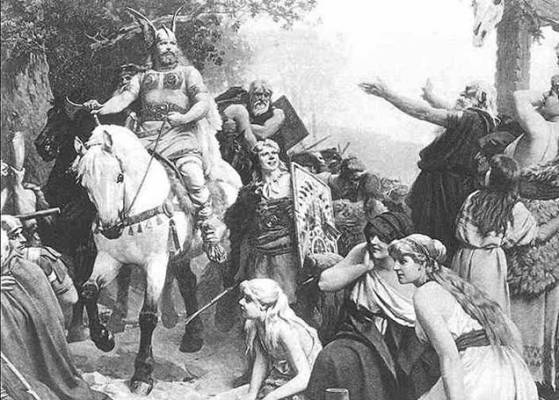
Mythical founders of The Germanic
Tribes
The preserved mythical founders and namesakes of some Germanic tribes:
- Angul - Angles (the Kings of Mercia, according to
the Anglo-Saxon Chronicle,
- other Anglo-Saxon dynasties are
derived from other descendants of Woden)
- ..........Burgundus -
Burgundians
- ....... ...................Cibidus - Cibidi
- ................................Dan - Danes
- .........................Francio - Franks
- .......................Nór
- Norwegians
- ............................Gothus - Goths
- ........................ Ingve - Ynglings
- .......................Irmin - Irminones
- .................Gambara
- Lombards
- .......................Seaxnēat - Saxons
- .... ..........Valagothus - Valagoths
- ............Suiones - Suiones (Svear)
- .................Thüringer
- Thuringii